Independent guide
Illegal dumping and roadside trash: why it happens and what helps
A general guide from Hollow & Headwater, an independent environmental journal. We can't take reports, haul trash or send anyone out. If you find a dump site, contact your county or local solid-waste authority.
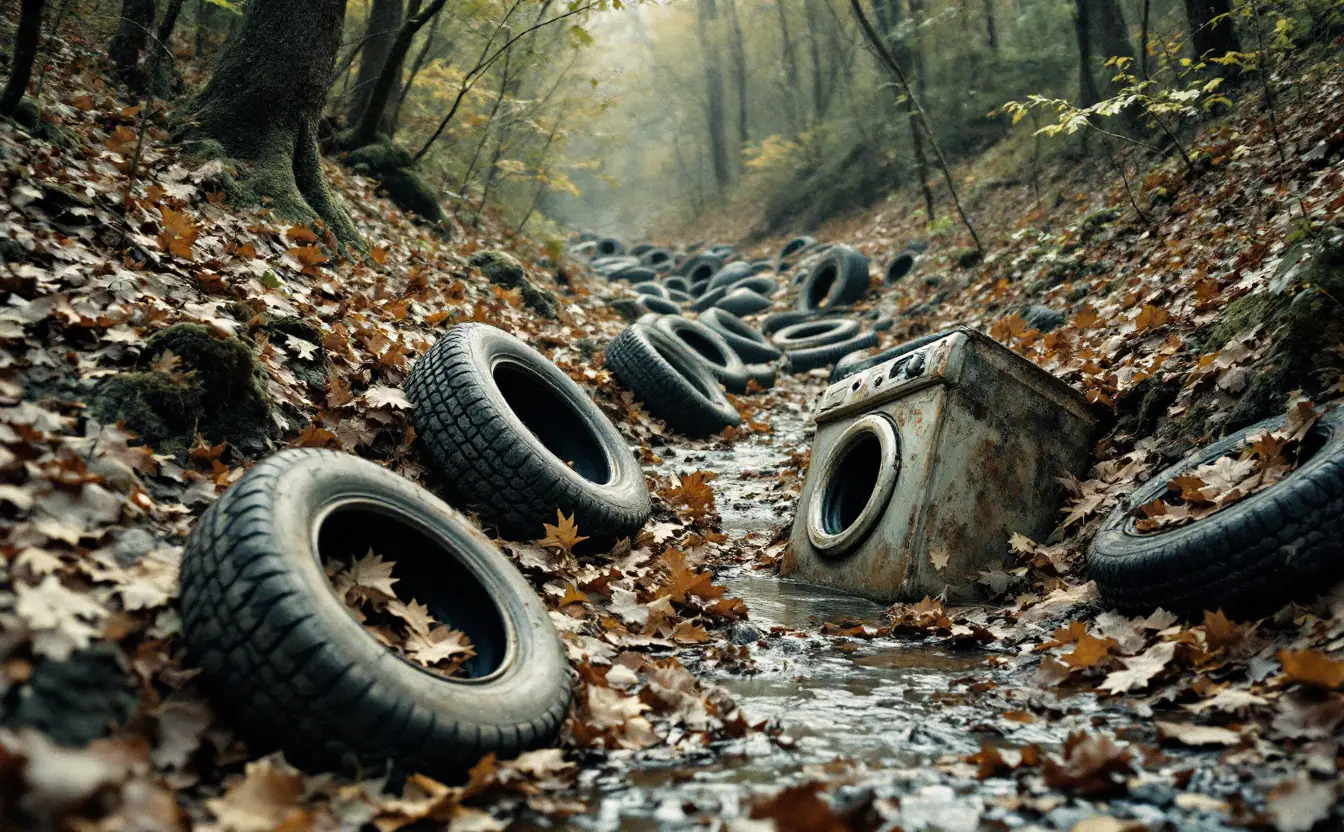
Most rural counties seem to have one: a gravel pull-off at the end of a back road where the guardrail stops and the slope drops toward a creek. Look over the edge and the layers tell the story. Last month's contractor bags on top, a sofa below them, a fan of bald tires, and at the bottom, half sunk in leaves, a washing machine from the era when appliances came in avocado green.
Illegal dumping is not only a rural problem. It turns up in desert washes outside Southwestern cities, in vacant lots in Great Lakes factory towns, along Gulf Coast bayous and in the sinkholes of the Missouri Ozarks. The junk changes a little from place to place. The reasons, the damage and the fixes are remarkably alike.
Litter and dumping are different problems
Litter is the cup tossed from a truck window or the wrapper that blows out of an overfull bin. It is careless, small and constant. Illegal dumping is deliberate: somebody loads a vehicle and drives somewhere to unload it. Both end up in streams, but they respond to different remedies. Litter is mostly about habits and packaging. Dumping is mostly about cost, convenience and the odds of getting caught.
Why people dump
Very few people dump for fun. The usual reasons are practical:
- Disposal costs money. Landfill tipping fees and per-item charges for tires, appliances and mattresses add up, and some people dodge them.
- There is no pickup. Large parts of the rural U.S. have no curbside collection, so every bag has to be hauled somewhere.
- The drop-off is far away or closed. A transfer station an hour off that shuts before most people finish work invites shortcuts.
- There is no way to haul it. Without a truck, a dead refrigerator is a genuine problem.
- Some contractors cut corners. Renovation debris, shingles and shop tires turn up at many dump sites.
- Old habits linger. Some sites have been used for generations, back to when burying trash at the edge of the property was normal.
- Trash attracts trash. A site that already holds junk looks acceptable, so more appears. Many communities find that clearing new dumping quickly is one of the best ways to keep a site clean.
What it does to streams and wildlife
Dumpers favor ravines, culverts and stream banks, places that are out of sight and downhill. That puts the trash exactly where the next flood can grab it. High water carries bags, bottles and foam downstream, drapes plastic in streamside trees and jams debris into culverts, which can back water up onto roads and yards in a storm.
Tires deserve a paragraph of their own. They hold rainwater for months and make ideal nurseries for mosquitoes, including the Asian tiger mosquito, which spread around the world partly through the trade in used tires. A tire pile that catches fire burns hot, smoky and stubborn, and the runoff carries oily residue.
Appliances and other castoffs bring their own baggage. Older refrigerators and air conditioners may still hold refrigerant and compressor oil. Car batteries leak acid and lead. Paint, solvents and motor oil soak into soil and seep toward groundwater. In karst country, where sinkholes and caves connect the surface to springs, whatever goes down a sinkhole can reach a spring or well with little filtering along the way.
For wildlife the harm is more direct. Animals get tangled in netting, fishing line and plastic strapping. Small mammals crawl into bottles and jars and cannot climb back out. Food waste draws raccoons, opossums and, in many regions, bears, which learn bad habits around people. Over time, plastics crack and shed fragments that join the microplastics already moving through rivers.
Prevention: what communities try
There is no single fix. Places that make headway usually combine several approaches:
| Approach | Why it helps | Watch out for |
|---|---|---|
| Free or cheap bulk-item drop-off days | Removes the cost and hassle behind much dumping | Needs a regular schedule and good publicity |
| Tire and appliance collection events | Targets the bulkiest, most troublesome items | Needs hauling arrangements and refrigerant recovery |
| Household hazardous waste days | Gives paint, solvents and chemicals a safe outlet | Often held only once or twice a year |
| Longer or evening hours at drop-off sites | Fits working people's schedules | Costs staff time |
| Lighting at chronic sites | Darkness is part of the appeal | Remote sites may lack power; solar units help |
| Cameras | Can deter and identify repeat dumpers | Needs a plan for who reviews footage and follows up |
| Gates, boulders or berms at pull-offs | Makes it harder to back a truck in | Can push dumping to the next pull-off |
| Fast cleanup of new dumping | Breaks the trash-attracts-trash cycle | Needs a reliable crew or volunteer network |
| Adopt-a-road and adopt-a-stream groups | Builds ownership and puts regular eyes on a site | Volunteers burn out without support |
Counties, solid-waste authorities, conservation districts and nonprofit groups run most of these efforts. If your area seems to lack them, asking your county or local solid-waste authority what already exists is a good first step. Habits at home matter too: our green tips page has a few, and our piece on where your recycling actually goes follows the materials that do get collected.
Organizing a cleanup
A good cleanup is mostly planning. Here is a workable sequence:
- Get permission. Find out who owns the land, whether a private owner, a county or a state or federal land manager, and get their okay.
- Talk to the solid-waste authority first. Ask where to take what you collect, whether fees can be waived for volunteer cleanups, and how to handle tires and appliances, which many landfills accept only separately.
- Scout the site. Walk it a week ahead. Note the slope, access, traffic, the creek and anything that looks hazardous.
- Gather gear. Puncture-resistant gloves, sturdy boots, long sleeves, trash grabbers, heavy bags, high-visibility vests near roads, a first-aid kit and plenty of water.
- Brief everyone. Cover the boundaries, the no-touch list below, safe lifting and where the road is.
- Sort as you go. Scrap metal and aluminum can often be recycled; keep tires and appliances apart from bagged trash.
- Record what you found. Counts and photos show the pattern and help make the case for prevention at that spot.
- Plan the follow-up. Come back in a few weeks and clear anything new before it attracts more.
Seasons bring their own hazards: ticks and poison ivy in summer, yellowjackets nesting in old debris in late summer and fall, slick banks and cold water in winter and spring. Stream banks under a dump are often steep and unstable, and no tire is worth wading into high or fast water.
The no-touch list
Some things should never be handled by volunteers. If you find any of these, leave them in place, keep people away, note the location and contact your county or local solid-waste authority. If there is immediate danger, such as fire, strong fumes or someone hurt, call emergency services.
- Drums, barrels or tanks, full or empty, especially stained ones or ones with unreadable labels
- Needles and syringes
- Unknown containers, powders or liquids, or anything giving off fumes
- Bottles with tubing, stained coffee filters and chemical cans found together, which can be waste from illegal drug labs
- Gas cylinders and propane tanks
- Old pipe insulation, siding or floor tiles that might contain asbestos
- Leaking batteries
- Ammunition, fireworks or anything that looks explosive
- Dead animals
Do not confront anyone you see dumping. A time, a place and a vehicle description passed to local authorities is safer and more useful than an argument at a pull-off.
Questions people ask
Is it worth cleaning a site that will just get dumped on again? Usually, yes. Clean sites tend to draw less new trash than messy ones, and a record of repeat dumping helps make the case for gates, lighting or cameras at that spot.
Can I burn or bury what I find? No. Burning trash releases smoke and toxic compounds, and burying it moves the problem underground and closer to groundwater. Most places restrict both. Take it to a proper facility.
What about a single bag of litter on my walk? Pick it up with gloves if it looks safe. The no-touch list still applies to anything hazardous, however small.
Who pays for cleanup on private land? Rules differ from place to place, and landowners are often left responsible even when someone else did the dumping. Ask your county or local solid-waste authority whether cleanup help, grants or fee waivers are available.
Independent publication – not affiliated with, endorsed by, or part of any government agency.