Independent guide
Erosion and sediment control on building sites: what good looks like
An independent explainer from Hollow & Headwater. We don't write, inspect or enforce construction rules, and nothing here is legal or regulatory advice; for the requirements that apply to a project, check with your local government or state environmental agency.
Stand on a bridge below a new subdivision during a summer thunderstorm and you can watch it happen. The creek coming down from the woods is the color of weak tea. Then a side ditch joins it, carrying water the color of chocolate milk, and for a quarter mile the two flows run side by side before the brown wins. In the red-clay Piedmont of Georgia and the Carolinas the plume looks almost orange; in the shale hills of Appalachia or the glacial soils of New England, tan or slate gray. Either way, soil that was a hillside yesterday is now in the stream.
Construction strips away the plants and topsoil that hold ground in place, and bare soil erodes many times faster than soil under grass or forest. The toolkit for keeping it on site is well understood, cheap compared with the damage it prevents, and easy to read once you know what to look for. This guide is for neighbors who walk past building sites, and for small builders and homeowners doing their own grading.
Why mud matters to a stream
Sediment is among the most common reasons streams end up on state lists of impaired waters, a system explained in our guide to what an impaired stream listing means. It does harm in several ways at once.
- It fills the gaps. The spaces between gravel and cobbles are where stream insects live and where trout, salmon and many minnows lay their eggs. Fine silt packs into those spaces, smothering eggs and squeezing out the animals fish feed on.
- It clouds the water. Muddy water blocks light for algae and plants at the base of the food web, and fish that hunt by sight struggle to feed.
- It carries hitchhikers. Phosphorus and some metals cling to soil particles and ride along into lakes and bays, where phosphorus can feed algae blooms. The Chesapeake Bay cleanup targets sediment along with nitrogen and phosphorus.
- It costs money downstream. Sediment fills culverts and reservoirs, and drinking water plants have to remove it.
Volunteers measure the result with pebble counts, described in our guide to kick-net stream monitoring. Below a muddy site, riffles that should be cobble start turning up sand and silt.
Erosion control and sediment control are different jobs
Erosion control keeps soil from moving in the first place: saving existing trees and grass, grading in phases instead of clearing everything at once, and mulching, seeding or covering bare ground. It works on the cause.
Sediment control catches soil after it has started moving: silt fence, check dams, sediment traps and basins, inlet protection. It treats the symptom.
Good sites lean on erosion control first and use sediment control as backup. Sand settles out quickly, but fine silt and clay can stay suspended for hours or days, so even a well-built basin lets some through. Ground that never erodes doesn't need catching.
The common controls, and how they work
Silt fence
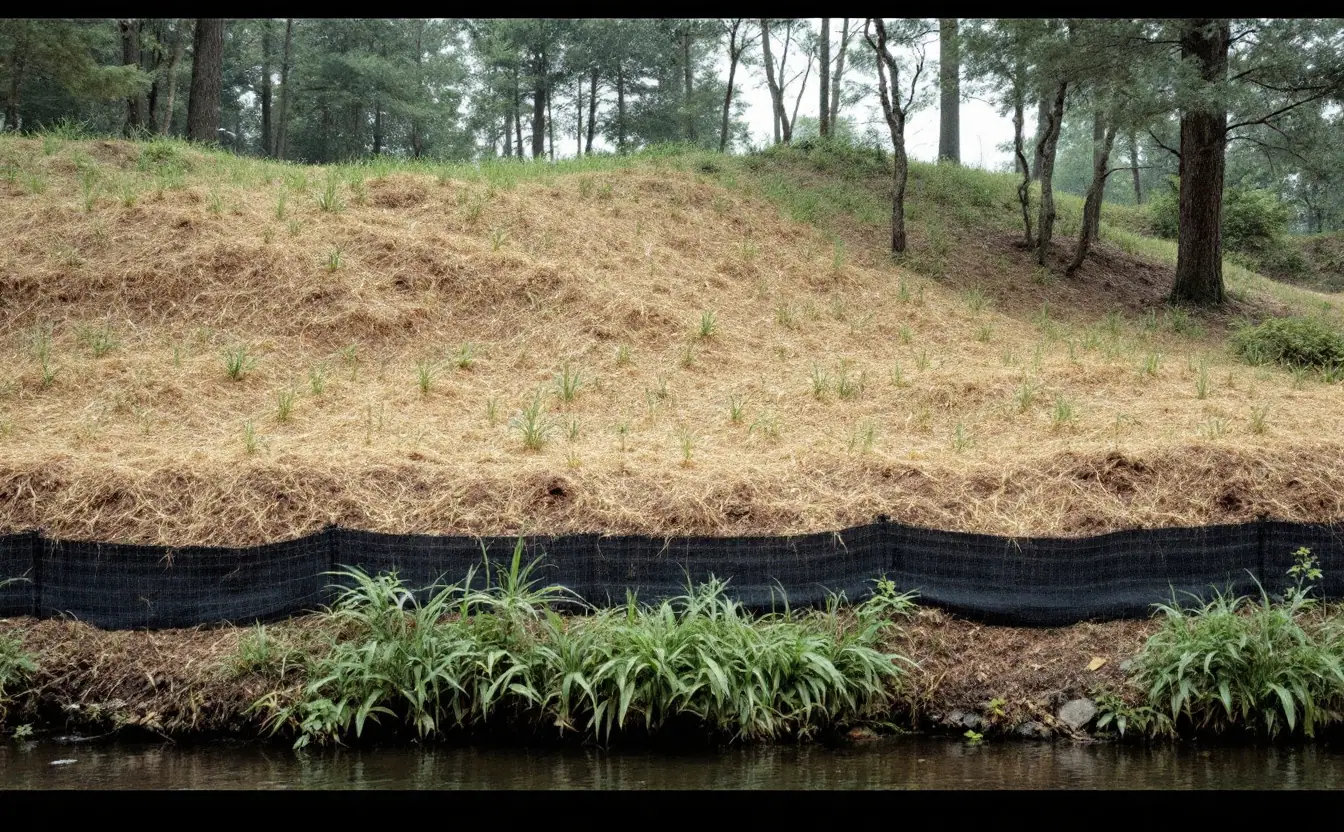
This is the low, dark fabric fence along the downhill edge of a lot. It slows sheet flow, water running off in a thin, spread-out layer, from a small area so sediment drops out behind it. It works only if the bottom edge is buried in a trench and backfilled, the fence follows the contour of the slope, the stakes sit on the downhill side, and the ends turn uphill so water can't simply run around them. It isn't designed for concentrated flow in a ditch; put it there and the first real storm will undercut or flatten it.
Check dams
These are small dams of rock or compost-filled tubes built across a ditch or swale. They slow water so it scours less and drops some of its load. The middle should sit lower than the ends so water spills over the center instead of cutting around the sides, and dams in a series are usually spaced so the base of one is about level with the top of the next one downhill.
Sediment traps and basins
Small pits or larger ponds hold muddy runoff long enough for particles to settle, often draining through an outlet that skims the clearer surface water. They need cleaning out as they fill. On fine clay soils settling alone often isn't enough, one more argument for keeping soil covered.
Stabilized construction entrances
A pad of large crushed stone, usually laid over filter fabric, marks the spot where trucks leave the site. The rough stone shakes mud loose from tires before they reach the road. Mud on the street is soil that will reach a storm drain at the next rain.
Inlet protection
Filter bags, rock rings or fabric barriers ring storm drain inlets near the site. In many towns storm drains run to the nearest creek untreated, so this is the last defense.
Seeding, mulch and blankets
This is the cheapest and most effective control of all. Temporary seeding with quick-growing grasses or cereal grains, such as annual ryegrass, oats in spring or cereal rye in fall, can hold soil within weeks. Straw mulch protects the surface while seed sprouts, or on its own when it's too late for seed. On steep slopes, erosion control blankets of straw or coconut fiber, pinned to the ground, do the job more securely.
Working versus failing: a field table
| Control | Working | Failing |
|---|---|---|
| Silt fence | Taut and upright, bottom edge buried, ends turned uphill, a thin layer of sediment on the uphill side | Sagging or flattened, water running under the bottom, gaps at the ends, sediment piled most of the way up, run straight up a slope or across a ditch |
| Check dams | Water spilling over the low center, sediment collecting behind each dam | Water cutting around the ends, rocks washed downstream, dams buried in sediment |
| Sediment basin | Water leaving clearer than it arrived, outlet intact, room left to fill | Full of mud, water short-circuiting straight to the outlet, banks eroding |
| Construction entrance | Clean, open stone and little mud on the road | Stone clogged with mud, tire tracks running down the street |
| Inlet protection | Barrier in place, water pooling and draining slowly | Bags torn, missing or bypassed, sediment fanning past the inlet |
| Seeding and mulch | Even straw cover or green growth soon after grading stops | Bare soil left for weeks, rills and small gullies forming, mulch blown away |
For small builders and homeowners
A house addition, a long driveway or a pond dig can send a surprising amount of soil downhill. A simple sequence keeps most of it at home.
- Plan before you clear. Mark the area you actually need to disturb, and protect the trees and grass outside it. Every square foot left vegetated is one you don't have to manage.
- Install perimeter controls first. Put silt fence along the downhill edge, a stone entrance where vehicles come and go, and protection on nearby drains, all before the first bucket of dirt moves.
- Divert clean water around the work. A shallow berm or swale above the site keeps uphill runoff from crossing bare ground.
- Put stockpiles in the right place. Keep soil and gravel piles away from ditches, drains and the stream, and cover or seed any pile that will sit for a while.
- Stabilize as you go. Seed and mulch finished areas right away rather than waiting until the whole project is done, and cover anything left idle.
- Watch the forecast. Avoid major grading ahead of heavy rain, which in steep country can arrive fast and hit hard; our piece on flash floods in steep terrain explains why.
- Inspect after every storm. Walk the controls after rain, fix undercut fence, restack rock and clean out sediment before the next storm comes.
Larger projects usually come under formal requirements in federal, state and local law, which vary by place. Check with your local government or state environmental agency before you break ground; this guide only explains how controls work.
For neighbors: reading a site from the sidewalk
The best time to look is during or just after rain. Is the water leaving the site clear or muddy? Is there a brown fan of sediment on the road or around a storm drain? Is the creek below the site a different color than above it? A dated photo taken from a public road records what you saw. Never walk onto an active site for a better look.
Plenty of builders fix problems quickly once someone points them out. If mud keeps reaching a stream, your local government or state environmental agency deals with construction runoff, and a clear note of where and when helps.
FAQ
Why do some sites use straw bales instead of silt fence?
Straw bale barriers were once common, but many erosion control manuals now discourage them for perimeter control because they're hard to set without gaps and they break down quickly. Loose straw spread as mulch is a different and very useful thing.
How long should silt fence stay up?
Until the ground above it is stabilized with established vegetation or permanent cover. Pulling it early is a common mistake; so is leaving it to rot for years after the grass fills in.
What should I plant to stop erosion on a bare slope?
For quick cover, sow a temporary grass or cereal grain together with a permanent seed mix suited to your region, then cover it with straw. On steep or shady banks, native shrubs and groundcovers hold soil well over the long run, and your county extension office can suggest species that thrive locally. By the second spring, a bank that bled mud with every storm can be knitted together with roots.
Independent publication – not affiliated with, endorsed by, or part of any government agency.