Independent guide
Kick-net stream monitoring: technique, bug groups and simple scores
This is an independent how-to from Hollow & Headwater, a journal rather than a monitoring program or a government agency. We don't train, certify or collect data from volunteers; your local watershed group can tell you which methods it follows.
A riffle in early April sounds like a room full of people talking quietly. The water is cold enough to ache through neoprene, the cobbles wear a thin brown film of algae, and under almost every stone something is holding on: flattened mayfly nymphs, stoneflies with their legs splayed like a crab's, caddisfly larvae tucked inside cases of sand grains. A kick net is simply a way to borrow those animals for half an hour, count them, and put them back.
Volunteers use kick nets everywhere from Appalachian trout streams to Ozark creeks and salmon tributaries in western Washington. This guide goes further into technique than our beginner's guide to volunteer stream monitoring.
Why the bugs are worth counting
A water sample describes the stream at the moment the bottle filled. Benthic macroinvertebrates, the backboneless animals of the stream bottom that are big enough to see, stay put for months or years and live through whatever happens: a summer of warm water, an oxygen sag below a leaking septic field, a storm that washes in mud. Because groups tolerate pollution differently, the mix in a riffle works like a long-running record.
They're practical, too: no lab, modest gear, and most animals can be identified to a useful level with a hand lens and a good key.
Choosing the riffle
Rectangular kick nets work best in riffles, the shallow, fast stretches floored with cobble and gravel, where the most variety usually lives. Look for a spot that is:
- Ankle- to knee-deep, with current you can stand in comfortably.
- Floored with stones roughly fist-sized to head-sized, not bedrock or pure sand.
- Typical of the reach, not directly below a bridge, culvert or tributary mouth.
- Reachable without crossing private land you lack permission for.
Sandy coastal plain streams and muddy-bottomed creeks often lack good riffles, so many groups use a D-frame net there to sweep banks, snags and plant beds. Scores from the two methods aren't directly comparable.
Working the net, step by step
A typical rectangular kick net is fine mesh stretched between two wooden poles, roughly a yard wide, worked by two people: one holds, one kicks. Where your group's protocol differs from this outline, follow the protocol.
- Approach from downstream. Walk up along the edge so you don't trample the patch you plan to sample, and if you'll take several kicks, start at the bottom of the riffle and work up.
- Set the net. The holder stands downstream, facing upstream, with the mesh across the current. Press the bottom edge flat on the streambed and tilt the poles back slightly so the mesh forms a shallow pocket. Set a stone on the bottom edge if the current lifts it; animals escape through any gap.
- Rub the big stones. In a patch directly upstream, about as wide and as long as the net, pick up each larger stone, hold it just upstream of the mesh, and rub it with your hands or a soft brush so clinging animals wash in. Set cleaned stones aside.
- Kick. Shuffle and dig into the remaining gravel with heels and toes for the time your protocol sets, often a minute or so, stirring the bottom a few inches deep so animals and debris drift into the mesh.
- Lift without losing the catch. The holder slides the bottom of the net forward and up in one scooping motion, so the current presses the catch into the mesh instead of washing it out underneath. Carry the net flat to the bank.
- Rinse it down. Rinse animals and debris into a tray or bucket with stream water, picking off any that cling to the mesh. Many protocols combine several kicks into one composite sample.
Sorting a sample
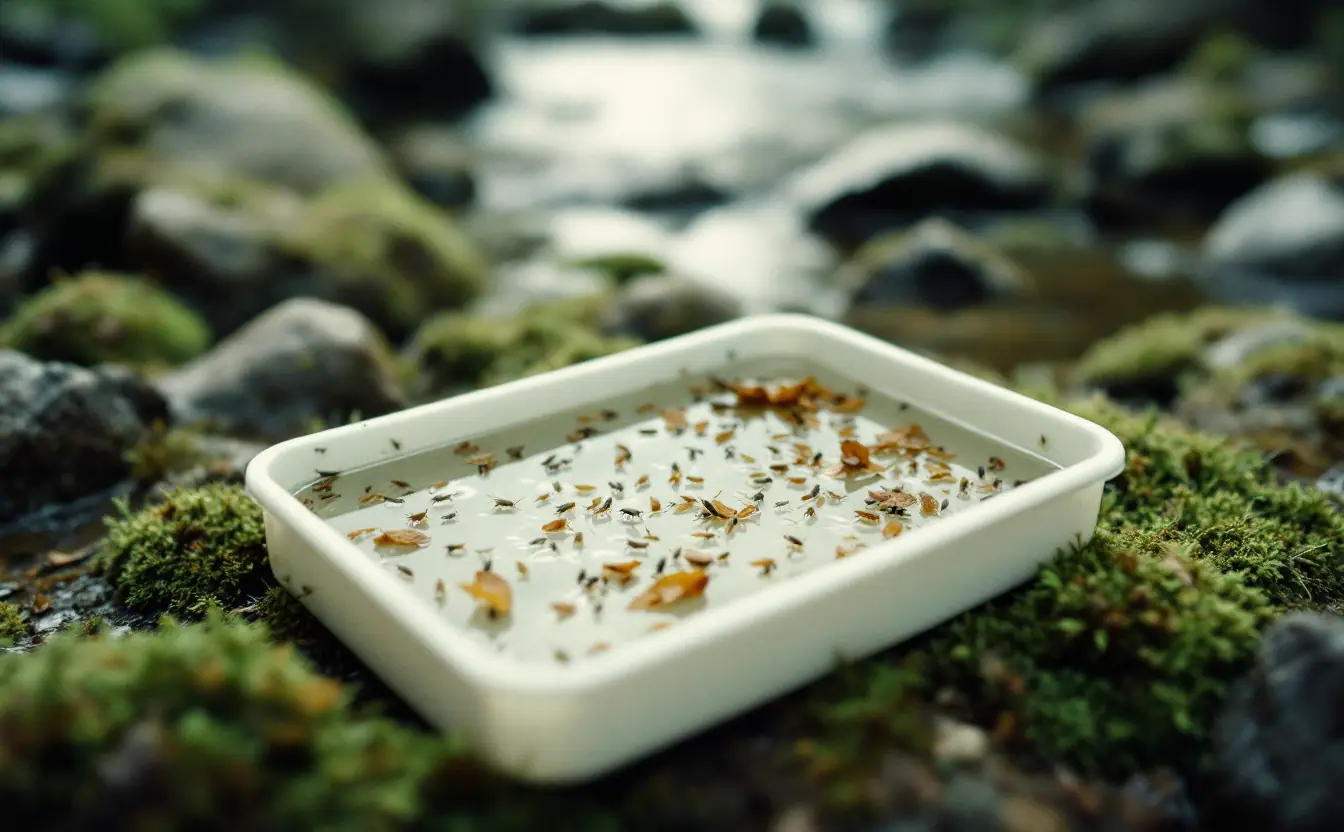
Pour the sample into a white tray with an inch of stream water and let it settle; within a minute, the debris starts to move. Keep the tray shaded, since animals in warm water die quickly.
Work from big to small, using forceps or an eyedropper to move animals into an ice cube tray, one kind per compartment, and tease apart leaf packs where small mayflies hide. Some methods pick the whole tray; others pick random squares of a gridded tray until they reach a set number of animals, which keeps effort consistent between visits. Afterward, return everything to the stream.
The three groups
Volunteer keys usually sort macroinvertebrates into three groups by pollution tolerance. A few animals sit in different groups depending on the key, so use the one your group uses.
| Group | Common examples | What a lot of them suggests |
|---|---|---|
| Pollution-sensitive | Stonefly nymphs, most mayfly nymphs, most caddisfly larvae, water pennies, riffle beetles, hellgrammites (dobsonfly larvae), gilled snails with a trapdoor-like operculum | Cool, well-oxygenated water and clean, open spaces between stones |
| Somewhat tolerant | Crayfish, scuds, sowbugs, dragonfly and damselfly nymphs, crane fly larvae, clams and mussels, net-spinning caddisflies (in some keys), fishfly and alderfly larvae | Moderate conditions; common in healthy streams, but they take over where conditions are stressed |
| Tolerant | Midge larvae, black fly larvae, aquatic worms, leeches, pouch snails and other lunged snails | Can survive low oxygen, warm water and organic pollution |
Finding tolerant animals is normal. Finding nothing else is the signal.
Turning a tray into a score
Most volunteer methods turn the tally into a simple biotic index. A widely used pattern: count how many different kinds of animals you found in each group (kinds, not individuals), multiply the sensitive count by three, the somewhat tolerant count by two and the tolerant count by one, and add them up. Higher totals point to better conditions.
With made-up numbers, for illustration only: five sensitive kinds, four somewhat tolerant and three tolerant gives (5 × 3) + (4 × 2) + (3 × 1) = 26. Each method sets its own rating bands, often tuned to a region's streams, so use your own key's cutoffs.
Another common measure is the share of mayflies, stoneflies and caddisflies, the three insect orders known together as EPT. Neither number is a diagnosis. Tiny headwater trickles, warm lowland streams and riffles scoured by a recent flood can all score low for natural reasons, which is why years of repeat visits tell you far more than one score.
Pebble counts: measuring the floor
Riffle animals depend on the spaces between stones, and fine sediment filling those spaces is one of the most common stresses on streams. A pebble count, sometimes called a Wolman count after the geomorphologist who popularized it, puts a number on the streambed.
Walk across the stream in a zigzag or along straight lines, heel to toe. At each step, reach down beside the tip of your boot without looking and pick up the first particle your fingertip touches. Measure its intermediate axis, the width that's neither longest nor shortest, and tally it by size class until you reach the total your method calls for, often a hundred particles.
| Size class | Intermediate axis |
|---|---|
| Silt and clay | Smaller than 0.062 mm; smooth or slick |
| Sand | 0.062 to 2 mm; gritty |
| Gravel | 2 to 64 mm |
| Cobble | 64 to 256 mm |
| Boulder | Larger than 256 mm |
| Bedrock | Solid rock floor |
A riffle that turns up mostly sand and silt where you'd expect cobble often points to excess sediment from upstream, which our guide to erosion and sediment control on building sites looks at from the source end.
Safety and clean gear
- Stay out of water deeper than your knees or faster than you can stand in easily, and never sample during high or muddy flow.
- Go with a partner and tell someone where you'll be.
- Wear boots with good grip, and use a wading staff on algae-slick cobble.
- Wear gloves below pastures, pipes and failing septic systems, and wash before eating.
- Plan for ticks, cold water in spring and fall, and summer thunderstorms.
- Clean, drain and dry nets, boots and trays before visiting another stream, so you don't spread didymo, New Zealand mudsnails or zebra mussel larvae.
Sharing what you find
Data is most useful when someone else can trust and reuse it. Record the date, time, exact location, weather, recent rain, water level, method and effort, who sampled, and the raw count for every kind of animal, not just the score.
Then give the data a home. Watershed associations, angling clubs, land trusts and extension services often keep long-term records for particular streams, and some pass quality-assured data to the public agencies that assess rivers. Ask first what methods the group uses and whether it follows a written quality-assurance plan, and share sharp drops in your scores promptly. Official assessments, explained in our guide to what an impaired stream listing means, are built on data, and local records often show change first.
FAQ
What's the best time of year to sample?
Many methods sample in spring and fall, when lots of insect larvae are big enough to identify and haven't yet emerged as adults. Sample in the same seasons each year so the results line up.
Is kick-netting harmful to the stream?
Done carefully, the disturbance is small and short-lived; the patch recolonizes from animals drifting down from upstream. Leave freshwater mussels where they are, since many species are rare and protected.
My score was low. Is the stream polluted?
Not necessarily. Resample in the same season, compare with a site upstream, and look at the pebble count and the weather before drawing conclusions. A low score after a quiet month in good flow is worth taking to your local group; a low score the week after a flood mostly tells you about the flood.
Independent publication – not affiliated with, endorsed by, or part of any government agency.