How to shock a well: bleach amounts, contact time and flushing
To shock a well, you pour enough plain, unscented household bleach into the water standing in the casing to reach a target chlorine strength, commonly somewhere between 50 and 200 ppm. Then you draw that water through every tap in the house, leave it for 12 to 24 hours, and flush it onto the ground well away from the septic field, gardens and streams. About 7 to 14 days later, once no chlorine remains, you retest for coliform bacteria.
The bleach dose comes from three measurements: the inside diameter of the casing, the depth of water standing in it, and the strength printed on the bleach label. The arithmetic is the easy part. Most of the mistakes happen around it: taps skipped, a dose guessed by eye, flush water sent down a ditch to the creek, a retest taken too soon.
When does a well need shocking?
Shock chlorination is a one-time disinfection. It kills bacteria that got into the well and plumbing during a specific event, and it suits these situations:
- A lab result positive for total coliform bacteria (with E. coli, follow your health department's advice closely, since that points to fecal contamination)
- After work on the well: a new pump, a pulled line, anything lowered down the casing
- After floodwater reached the wellhead, once the water has receded and an electrician has checked any wiring that got wet
- A new well before first use, if the driller did not already disinfect it
It is not a cure for a steady source of contamination, and it does nothing for chemistry. More on that near the end.
About these links: some go to Amazon and partner shops and may earn us a commission. As an Amazon Associate I earn from qualifying purchases.
What you need before you start
- Plain, unscented household bleach in a fresh bottle, with the percentage of sodium hypochlorite printed on the label (usually about 5 to 8.25%). Never use splash-less or scented bleach. Bleach loses strength as it ages, especially in a hot garage.
- Rubber gloves, eye protection and clothes you do not mind spotting
- A clean bucket and a funnel
- A garden hose long enough to reach from an outdoor faucet back to the well
- High-range chlorine test strips
- Stored drinking water for at least a day
- Your well log, or whatever record you have of the well's depth and water level
 Chlorine test strips, 0 to 500 ppmHigh-range strips to confirm a well shock reached its target and, later, that the chlorine is gone.$15.99 Price seen on Amazon Oct 20, 2026, 12:34 PM ETDetails at Amazon ›
 Safe Home bacteria-in-water testA presence or absence test for coliform bacteria, read at home after the incubation time.$14.99 Price seen on Amazon Oct 20, 2026, 12:34 PM ETDetails at Amazon ›
Product prices and availability are accurate as of the date/time indicated and are subject to change.
I settled on these two from the makers' specifications and directions, and from comments that recur across owner reviews; neither has sat beside a lab instrument on my bench. Of the pair, the strips matter more. A shock is easy to underdose and hard to judge by smell alone, and the bacteria test only earns its place two weeks later.
How much bleach does a well need?
Our well shock chlorination calculator takes four inputs: casing diameter, depth of standing water, target strength and bleach percentage.
Casing diameter. Measure the inside of the casing with the cap off, or read it from the well log. Each foot of water in a round casing holds 0.0408 times the diameter squared, in gallons:
| Casing inside diameter | Water per foot of depth |
|---|---|
| 4 in | about 0.65 gal |
| 5 in | about 1.02 gal |
| 6 in | about 1.47 gal |
| 8 in | about 2.61 gal |
| 36 in (dug well) | about 52.9 gal |
That last row explains why dug wells take so much more bleach than drilled ones.
Depth of standing water. This is not the depth of the well. It is the column of water inside it: total depth minus the static water level, both of which usually appear on the driller's log. A 180-foot well with water standing 80 feet down holds a 100-foot column. If you have no log, many states keep driller records, or a well contractor can measure it. Do not lower a weighted line blind; it can snag on the pump wiring.
Target strength. The gauge offers 50, 100 and 200 ppm, which covers the range that published instructions commonly use. Follow the figure your health department or contractor gives you. More is not better: bleach is alkaline, and a heavy overdose pushes the pH up, where chlorine works less well, and it is harder on pump parts and on the ground where you flush.
Bleach strength. Type in the percentage from the label.
Here is the gauge's default case worked through. A 6-inch casing holds about 1.47 gallons per foot, so 100 feet of water is about 147 gallons. The formula is bleach gallons = water gallons × ppm ÷ (bleach % × 10,000), since 1% equals 10,000 ppm. At 100 ppm with 6% bleach, that comes to about 0.24 gallon, or 31 fluid ounces, or roughly 3.9 cups. Switch to 8.25% bleach and it drops to under 3 cups; double the target to 200 ppm with 6% bleach and it climbs to nearly 8.
The gauge counts only the water in the casing. The pressure tank, pipes and water heater hold more, and they fill with chlorinated water from the well when you open the taps, which thins the dose. That is why the strips matter more than the arithmetic.
Step by step
- Pick your timing. Start in late afternoon so the contact time runs overnight, and set drinking water aside.
- Bypass treatment equipment. Softeners, carbon filters, reverse osmosis units and UV lamps each have their own instructions; shock-strength chlorine can damage some membranes and spends carbon quickly.
- Switch off the pump at the breaker, then remove the cap or vent plug. Look for a cracked seal, gaps, insects or mouse nests while you are there.
- Mix the bleach into a few gallons of water in the bucket and pour it down the casing through the funnel, keeping it off the wiring.
- Recirculate. Turn the pump back on, run the garden hose from the nearest outdoor faucet into the casing, and wash down the inside walls until the hose water smells strongly of chlorine. Check it with a strip.
- Draw it through the house. Open every tap, hot and cold, one at a time, until each smells of chlorine, then close it. Flush each toilet, and remember outdoor faucets and the washer lines. Follow the water heater maker's guidance for the heater. If the farthest taps read well below your target, many instructions call for adding more bleach and recirculating again.
- Replace the cap and wait 12 to 24 hours. Do not drink the water, cook with it or bathe in it.
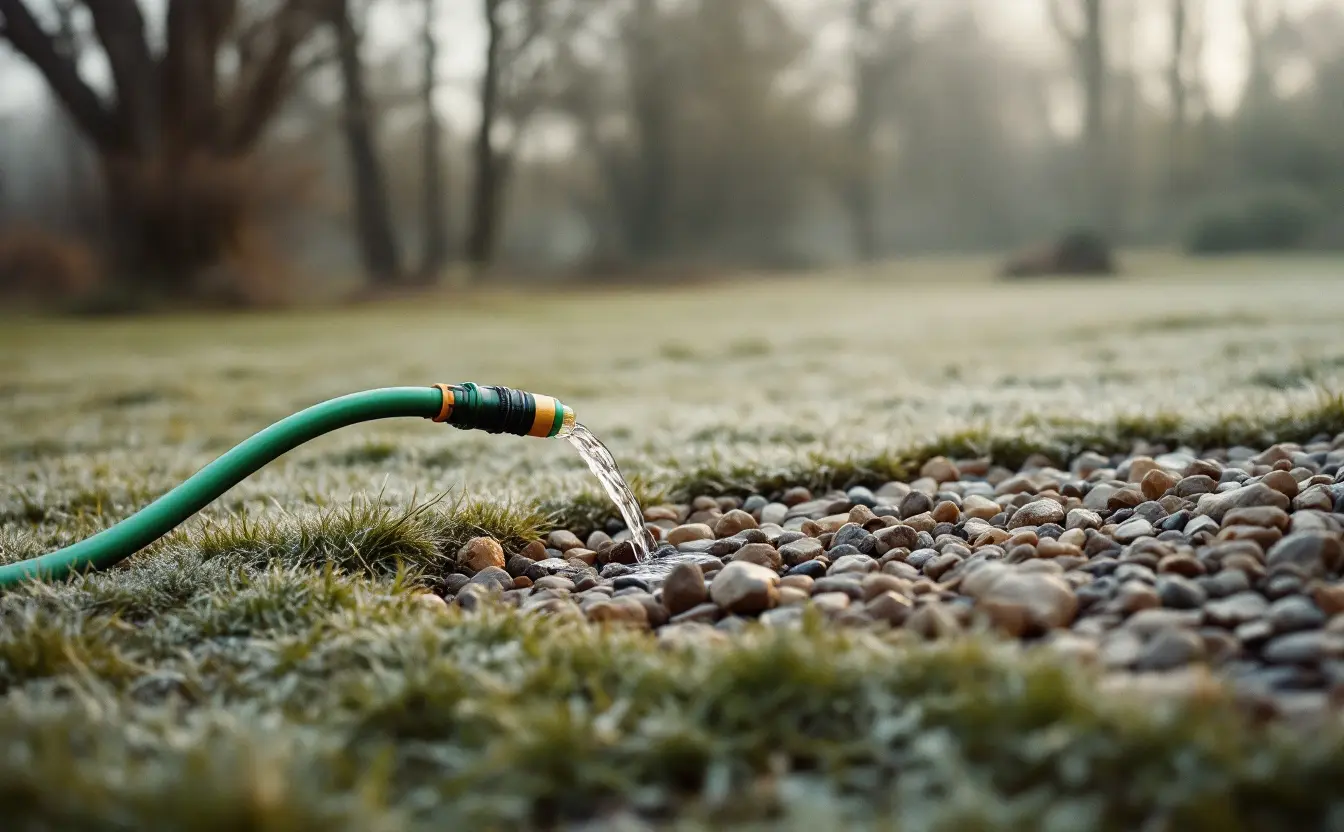
- Flush it outside. Run a hose onto gravel or rough ground far from the septic field, gardens, ponds, streams and any ditch that drains toward them. Keep going until the smell fades and a strip reads at or near zero. If the water clouds or the flow sags, stop and let the well recover; a low-yield well can be pumped down.
- Clear the indoor lines briefly, then reconnect your treatment equipment. Carbon cartridges may need replacing.
- Retest for coliform about 7 to 14 days later, once no chlorine remains. Our guide to well water test kits covers home screens, certified labs and how to take a clean sample.
Why the flush water needs a careful route
Shock-strength chlorine is meant to kill everything it touches, and it does not stop at the end of the hose. A septic system works because of bacteria in the tank and in the soil of the drain field. A large slug of chlorinated water knocks them back, and sheer volume can flood the field.
Streams are my soft spot. I spent years turning over cobbles to count mayfly and stonefly nymphs, and those animals live with whatever comes down the bank. A ditch that looks dry in October can carry your flush straight to a headwater creek, and to every sculpin and crayfish living in it. Gravel, a rough patch of ground downhill, or a wide lawn far from the water is a better home for it, spread over a few hours. More on how small creeks work lives under our water and rivers theme.
When won't shocking fix the problem?
When bacteria keep coming back. If a careful shock clears the well and the next test or the one after turns positive again, something is letting surface water in. Common culprits are a loose or cracked cap, a corroded or cracked casing, a failed seal around the outside of the casing, a wellhead that ends in a pit or below grade, water pooling against the casing, or a septic field or barnyard too close upslope. A licensed well contractor can inspect and repair these.
When the well itself is shallow and open. Dug wells and springs draw from water close to the surface and often test positive again after a shock. Continuous disinfection, such as an ultraviolet unit, or a properly cased drilled well may be the longer answer.
When the problem is chemistry. Chlorine does nothing for nitrate, arsenic, lead, radon, hardness or salt. Each needs its own treatment, chosen from a lab result.
When the bacteria are nuisance types. Iron and sulfur bacteria that cause slime and odors can return within weeks or months, so a shock may buy time rather than a cure.
The U.S. EPA's private well pages link to state guidance, and your state or county health department may publish its own step-by-step version worth comparing with this one.
Questions
How soon can I drink the water after shocking the well?
Not until the chlorine has been flushed and a strip reads at or near zero. If you shocked because of a positive bacteria test, keep using bottled or boiled water until the retest comes back clean, which is what health departments typically advise.
Can I use pool chlorine or splash-less bleach instead?
Use plain, unscented household bleach. Splash-less and scented bleaches carry thickeners and fragrances you do not want in a well, and pool tablets often contain stabilizers meant for swimming pools rather than drinking water.
Should I shock my well every year as routine maintenance?
Shock when there is a reason: a positive test, well work, a flood. A yearly bacteria test tells you whether there is a reason, and routine shocking without one can hide a leak you ought to find.
Will shocking my well harm the septic system?
It can if most of the flush water goes down the drains. Run the bulk of it outside, onto ground away from the drain field, and keep the indoor flushing brief.