Conservation & Wildlife · Water & Rivers
Hellbenders, mudpuppies and other giants of North American streams
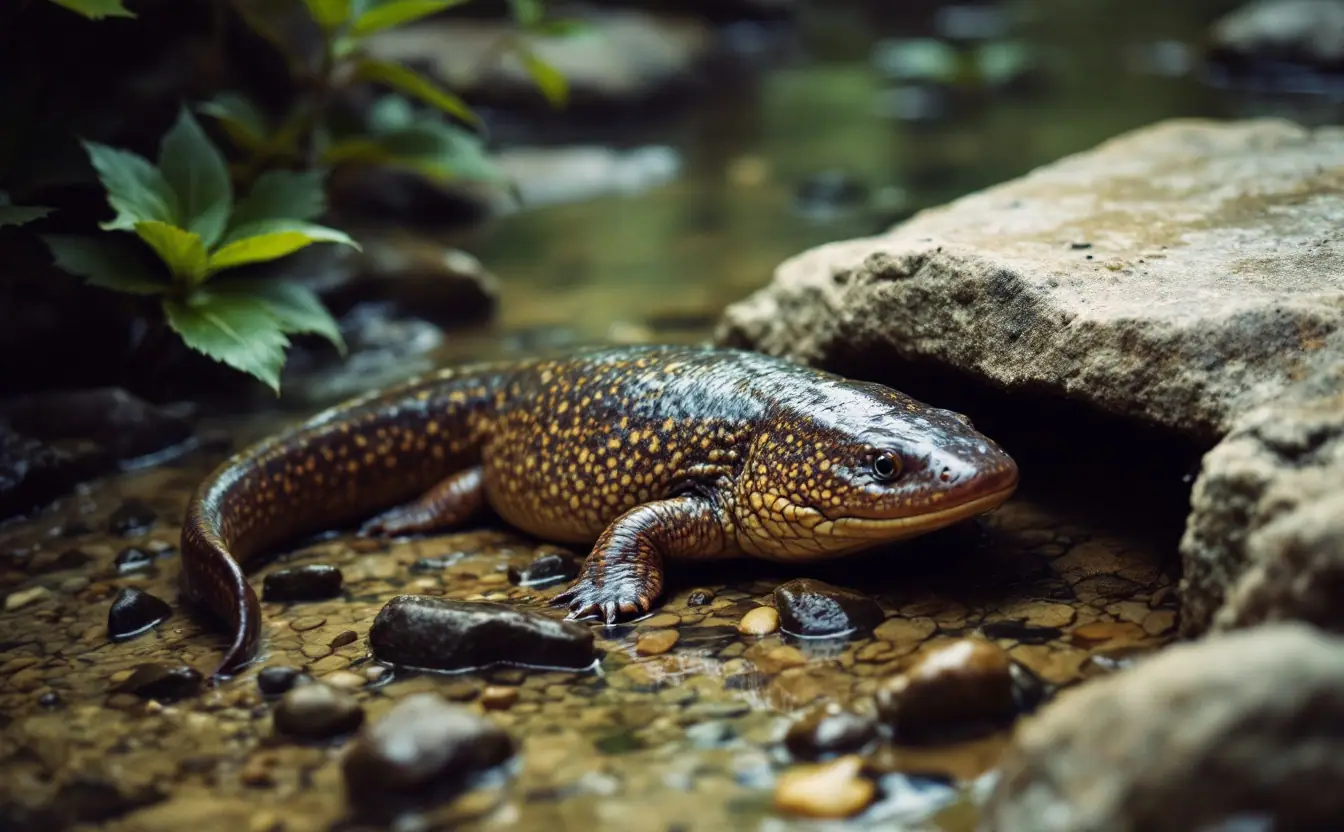
The first hellbender I ever met was tucked under a slab of sandstone about the size of a card table, in a creek so clear I could count pebbles from the bank. For a long moment I took it for a waterlogged stick furred with algae. Then the stick lifted a flat, rounded head, rippled the loose skin along its sides, and slid back into the dark. I stayed on that bank for most of an hour afterward, mostly grinning.
Hellbenders are the largest salamanders in North America, and they are odd in all the best ways: wrinkled, slimy, with eyes so small they look like an afterthought, and harmless to people. They also make a fine measuring stick for a stream. Where they still live in good numbers, the water is usually cold, clean and full of oxygen, and the rocks on the bottom have open space underneath them.
What follows is a field guide of sorts to the hellbender and its big aquatic relatives in the eastern half of the continent. What they need, it turns out, is what any healthy creek needs.
Meet the hellbender
The scientific name, Cryptobranchus alleganiensis, means roughly "hidden gill from the Alleghenies," and both halves fit. Adults have no visible gills, and the species is at home in the cool, rocky rivers of the Appalachians, from southern New York into the hills of northern Georgia and Alabama, and west through the Ohio and Tennessee River drainages. A separate subspecies, the Ozark hellbender, lives in a handful of spring-fed rivers in southern Missouri and northern Arkansas.
Its folk names include snot otter, mud devil, devil dog and Allegheny alligator, none of them fair. A big adult stretches well over a foot long and now and then approaches two feet, with a broad flattened head, a rudder of a tail and a body the color of creek mud, anywhere from olive to rusty brown, often with darker blotches. Its relatives across the Pacific, the giant salamanders of China and Japan, grow larger still, but nothing else on this continent comes close.
A body built for breathing water
Look along a hellbender's flanks (from a respectful distance) and you'll see thick folds of skin hanging like a shirt two sizes too big. Hellbenders have lungs, but they depend mostly on their skin to draw oxygen from the water, and the wrinkles give that skin far more surface to work with. When oxygen runs short, a hellbender will sometimes rock or sway in place to keep fresh water moving over its body.
That arrangement only works in water cold enough and fast enough to carry plenty of dissolved oxygen. A hellbender can't haul out and gulp air the way a frog can, so it is bound to the condition of its stream more tightly than almost anything else living there.
What it eats and when it moves
By day a hellbender hides beneath a large flat rock, usually one with an opening that faces downstream. At night it hunts, mostly for crayfish, with small fish, aquatic insects and the odd worm thrown in. It feeds by snapping its wide mouth open so suddenly that prey is sucked in with the water. Individuals tend to stay in one short stretch of stream for years, cycling among the same few shelter rocks.
The family at a glance
Big aquatic salamanders are easy to confuse. Here's how the main North American kinds compare. Sizes are typical adult lengths, and individuals vary.
| Animal | Where to look | Typical adult size | Gills | Telltale feature |
|---|---|---|---|---|
| Eastern hellbender | Clear, cold, rocky rivers from southern New York to northern Georgia and Alabama, west into the Ohio and Tennessee basins | Often 12 to 20 inches | None visible | Loose, wrinkled skin folds along the sides |
| Ozark hellbender | A few spring-fed Ozark rivers in Missouri and Arkansas | Similar to the eastern form | None visible | Bold dark blotching; a very small range |
| Common mudpuppy | Great Lakes, St. Lawrence, and much of the Mississippi and Ohio basins, in both lakes and rivers | Usually 8 to 13 inches | Bushy, deep red, kept for life | Four toes on every foot; dark spots on gray-brown skin |
| Southern waterdogs | Rivers and streams of the Southeast | Smaller than mudpuppies | Bushy, external | Several related species, each tied to its own river systems |
| Two-toed amphiuma | Swamps, ditches and slow water of the southeastern coastal plain | Can exceed three feet | None visible | Eel-like body with four tiny legs |
| Greater siren | Weedy ponds, swamps and sluggish streams of the Southeast | Up to about three feet | Bushy, external | Front legs only, no hind legs |
The last two rows are there mostly so you can rule them out. Amphiumas and sirens belong to warm, muddy, slow water, not rocky mountain streams. Along the Ohio or the upper Mississippi, though, the hellbender-or-mudpuppy question comes up often. The quickest check is the gills: a mudpuppy wears a feathery red plume on each side of its head its whole life, and a hellbender doesn't.
The mudpuppy and its passenger
The mudpuppy never fully grows up, at least in the usual amphibian sense: it keeps its larval gills for life and never leaves the water. It stays active straight through winter, which is why people ice fishing on northern lakes sometimes reel one up and get the surprise of their season. Despite the old story behind its name, it does not bark.
It also carries a remarkable hitchhiker. Most freshwater mussels have larvae that must clamp onto a fish's gills for a time before dropping off to settle into the gravel. The salamander mussel, a small and now uncommon species of the Ohio and upper Mississippi basins, is the known exception: its larvae ride on the mudpuppy instead. The mussel even lives under the same flat rocks the salamander uses for shelter. Lose the mudpuppy from a river and the mussel loses its only way to raise a next generation there.
A season of nests
Late summer into early fall is hellbender nesting season, which makes September a good month to think about them and a poor month to go flipping rocks. A male excavates a cavity beneath a large stone and defends it. One or more females lay hundreds of eggs inside in long strings that look like beads on a necklace, and the male fertilizes them in the water, outside the body, an unusual habit among salamanders. Our field almanac tracks this and other streamside events month by month.
Then he stays. The male guards the eggs through the weeks it takes them to hatch and often keeps watch over the larvae for a while afterward, chasing off intruders, including other hellbenders with an appetite for eggs. Young hellbenders carry external gills at first and lose them somewhere around a year and a half to two years of age. Several more years pass before they are ready to breed, and an adult that dodges trouble can live for decades. A species built on slow growth and long lives also recovers slowly when something goes wrong.
Why clear water matters so much
When biologists talk about what has gone wrong for hellbenders in parts of their range, sediment comes up again and again. Soil washing off construction sites, eroding banks, logging roads and bare fields settles into the gaps under rocks, the exact spaces hellbenders need for shelter and nests. A rock sitting flush in silt is just a rock. A rock with a dark gap under it is a home.
Warmer water holds less oxygen, which matters a great deal to an animal that breathes through its skin. Dams turn running rivers into still pools and split populations apart. Pollution, disease and illegal collecting add more pressure. The Ozark hellbender declined far enough to be listed as federally endangered, and many states treat the eastern hellbender as a species of concern. Zoos and wildlife biologists have bred hellbenders in captivity and raised young for release into their home rivers, slow and careful work that buys time while stream habitat recovers.
To see how your own creek is faring, our guide to reading a stream water quality report walks through dissolved oxygen, temperature and turbidity, the measurements that matter most to a hellbender. If you'd like to gather those numbers yourself, volunteer stream monitoring is a good way in.
Smaller giants under the same rocks
Kneel in a hellbender stream with a kick net and you'll meet the neighbors, some of them surprisingly large. Hellgrammites, the larvae of dobsonflies, can be as long as your finger, with pincer jaws and a fringe of feathery filaments down each side. They are fierce hunters of other insects, prized bait among many anglers, and a decent sign of good water, since they don't hold up under heavy pollution.
Crayfish, the hellbender's main food, are everywhere in a healthy stream, backing under stones and raising their claws at your fingertips. Freshwater mussels may share the bottom too, half buried in gravel and filtering the water around them, and some species live for many decades. A stream with hellbenders, hellgrammites, crayfish and mussels all present is a stream doing a great many things right.
Being a good neighbor to a stream giant
Most of us will never see a hellbender, and that's fine. The most useful help we can offer is to leave things the way we found them.
- Leave rocks where they are. Flipping, stacking, or building little dams and cairns in a stream destroys shelter for salamanders, crayfish and insects. During nesting season it can expose eggs to predators.
- Don't handle them. A hellbender's slime protects its skin, and handling can harm it. In many states it is also illegal to collect or keep one.
- If you hook one, cut the line. Hellbenders sometimes take bait. Many wildlife agencies suggest clipping the line as close to the mouth as you safely can and letting the animal go.
- Keep trees on the banks. Shade keeps water cool, and roots hold soil out of the channel. If you own creek frontage, leave a wooded strip along it.
- Share what you see. A clear photo and a general location help biologists track where hellbenders persist. State wildlife agencies and university herpetology programs often welcome sightings.
Some evening in early fall, find a cold creek with big flat rocks and sit still beside it while the light goes. You almost certainly won't see a hellbender. But under one of those slabs a father may be guarding a nest of beaded eggs, and the water sliding past him is the same water you're listening to.
Hollow & Headwater is an independent publication. Nothing here is official guidance – for permits, rules or emergencies, go to the relevant public authority.