Conservation & Wildlife · Outdoor Recreation
Roadside wildflowers: a spring field guide from ditch to roadcut
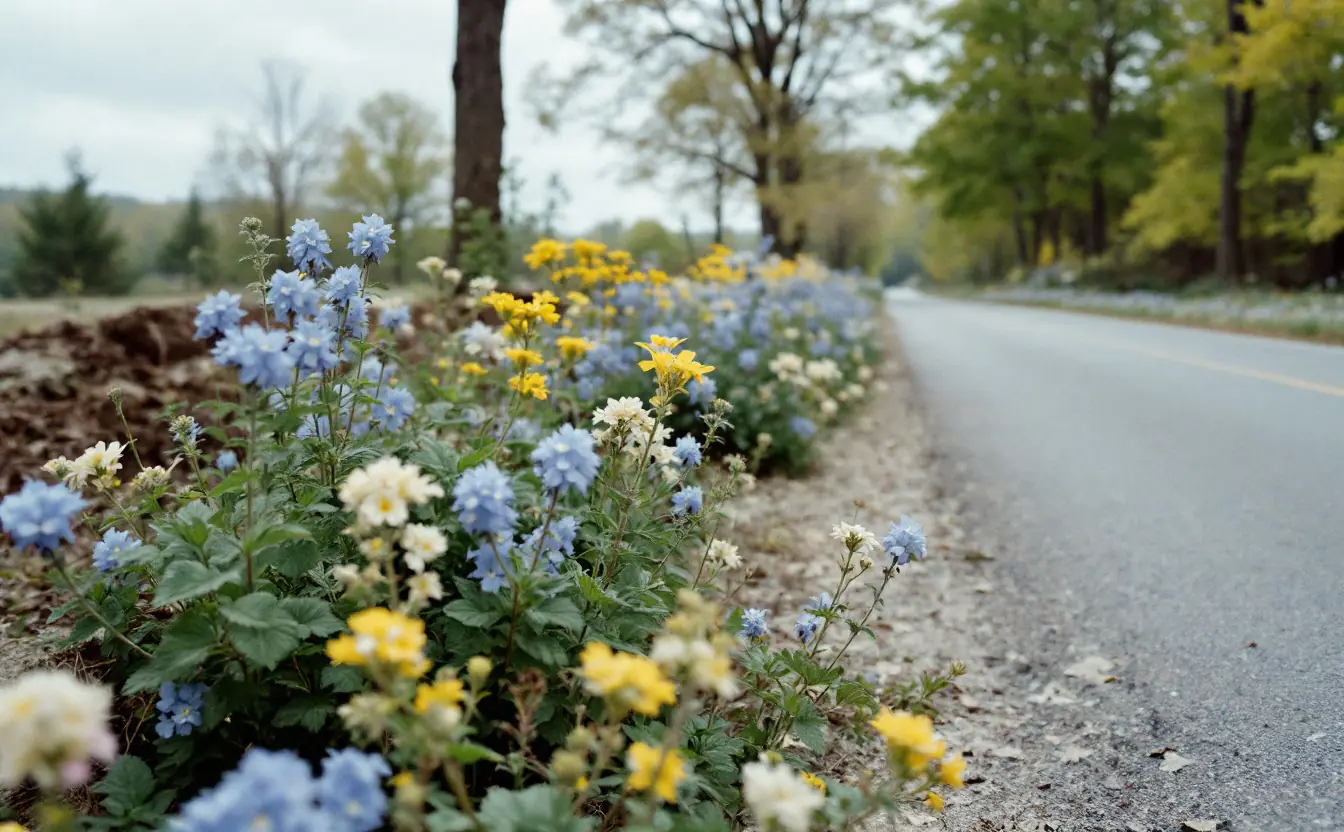
Every spring I meet more wildflowers through a car window than on any trail. The roadside is the one habitat nearly everybody passes through every day, and from late March into May it puts on a show that changes week by week: a haze of magenta redbud along the woods, yellow coltsfoot on a raw bank, a whole ditch gone gold with ragwort. Most people see a pleasant blur of color. With a little practice you can name most of it from the passenger seat, and the rest when you pull over.
When I taught school, I used to tell my students that a field guide is really just a way of asking better questions. Where is this growing? How many petals does it have, and what shape are they? What are the leaves doing? Roadsides are a fine place to practice those questions, because the same few dozen plants turn up along thousands of miles of them, and because the road itself sorts them into neat strips for you.
Read the roadside in bands
Most rural roads share the same cross-section, and each strip of it suits a different set of plants. Learn the bands and you will know where to look before you know what you are looking at.
- The mowed shoulder. Short, trampled, salted in winter and mowed in summer. Tough, low plants live here, many of them introduced from Europe: dandelions, clovers, henbit and purple dead-nettle, with bluets and violets where the soil is poor and thin.
- The ditch. Wet in spring, sometimes with standing water. This is the place for plants that like wet feet: golden ragwort and butterweed in the East and South, marsh marigold farther north, and later on blue flag iris.
- The backslope and roadcut. Raw soil or bare rock where the road was blasted or dug into the hill. Pioneers and cliff-dwellers grow here: coltsfoot, wild columbine, fire pink, mosses, and the crownvetch and grasses that road builders planted to hold the bank.
- The woods edge. Partial sun and leaf litter. Here are the flowering trees, redbud, dogwood and serviceberry, with bloodroot, wild blue phlox, trillium and mayapple beneath them.
In the West and on the Plains, roads often run through open country with no woods edge at all, and the whole verge behaves like a meadow. That is where the famous roadside shows happen: bluebonnets in Texas, poppies in California, balsamroot across the dry hills of the interior Northwest.
The field guide table
This table covers common spring roadside flowers across several regions. Bloom times are given in broad terms because they shift with latitude and elevation. Spring climbs a mountain the way fall color comes down one, so a flower finished in the valley may just be opening on the ridge; our piece on chasing fall color by elevation explains the same effect running in reverse.
| Flower | What to look for | Where on the roadside | When | Native? |
|---|---|---|---|---|
| Coltsfoot | Yellow, dandelion-like heads on scaly, reddish stalks; no leaves yet | Raw banks and roadcuts, East and Great Lakes | Earliest spring | No, from Eurasia |
| Purple dead-nettle | Small pinkish-purple hooded flowers, purple-tinted upper leaves, square stem | Shoulders and fallow fields, East, South and Midwest | Early spring | No |
| Spring beauty | Five white to pale pink petals with darker pink stripes; grass-like leaves | Lawns, shoulders and woods edges, East and Midwest | Early spring | Yes |
| Bloodroot | Single white flower with many petals; one leaf wrapped around the stem; orange sap | Woods edges, East | Early spring | Yes |
| Eastern redbud | Small magenta-pink pea-like flowers crowded on bare branches | Woods edges, East, Ozarks and Texas | Early to mid-spring | Yes |
| Bluets | Tiny pale blue four-petaled flowers with a yellow eye, growing in patches | Mowed banks and thin soil, East | Early to mid-spring | Yes |
| Virginia bluebells | Nodding sky-blue trumpets, pink in bud | River roads and floodplains, East and Midwest | Mid-spring | Yes |
| Golden ragwort and butterweed | Flat-topped clusters of yellow daisy-like flowers | Wet ditches and low fields, East and South | Mid-spring | Yes |
| Wild blue phlox | Five pale blue to lavender petals, often notched at the tip | Woods edges and shady banks, East | Mid-spring | Yes |
| Garlic mustard | Small white four-petaled flowers, scalloped leaves, garlic smell when crushed | Shady edges, East and Midwest | Mid-spring | No, and invasive |
| Wild columbine | Nodding red-and-yellow flowers with long spurs | Rocky roadcuts and ledges, East and Midwest | Mid- to late spring | Yes |
| Fire pink | Five narrow scarlet petals, each notched at the tip | Rocky banks, Appalachians and Ozarks | Mid- to late spring | Yes |
| Dame's rocket | Four petals in purple, pink or white on a tall plant; sweet evening scent | Ditches and edges, North and East | Late spring | No |
| Texas bluebonnet | Blue flower spikes with white tips | Open verges, Texas | Early to mid-spring | Yes |
| California poppy | Silky orange cups that close at night and under cloud | Open verges, California and the West | Spring | Yes |
| Arrowleaf balsamroot | Big yellow sunflower-like heads; silvery, arrow-shaped leaves | Dry hillsides, interior West | Mid- to late spring | Yes |
If a plant stumps you, the USDA's PLANTS Database shows range maps by state and whether a species is native where you live. For a running sense of what is opening when, our field almanac tracks bloom and bird arrivals month by month.
Look-alikes worth learning
A handful of roadside pairs fool nearly everyone at first. Each comes apart with one or two good questions.
Phlox or dame's rocket?
In late spring, ditches across the North and East fill with tall purple, pink and white flowers that people often call wild phlox. Much of the time it is dame's rocket, a European garden plant that escaped long ago. Count the petals: phlox has five, dame's rocket has four, arranged in a cross like every member of the mustard family. The leaves help too, since phlox leaves sit opposite each other on the stem while dame's rocket leaves alternate and have toothed edges.
Henbit or purple dead-nettle?
Both are European mints with square stems and small pink-purple flowers, and they often grow side by side in the same field, turning it lavender in March. Henbit's round, scalloped leaves clasp the stem in tiers, like a stack of collars, with no purple tinge. Purple dead-nettle has stalked, more triangular leaves, and the top of the plant is washed with purple, as if it were blushing. Bees visit both heavily on the first warm days, when little else is open.
Coltsfoot or dandelion?
Coltsfoot blooms first, on stalks covered with reddish scales, and there are no leaves in sight when it flowers. The big, hoof-shaped leaves that gave it the name come up weeks later, after the flowers are done. A dandelion has its rosette of jagged leaves right there at bloom time, a smooth hollow stalk and milky sap. Coltsfoot also favors raw, bare banks where few dandelions bother to grow.
Golden ragwort or butterweed?
These two yellow cousins brighten wet ground at about the same time. Golden ragwort is a perennial that spreads in colonies, with heart-shaped, long-stalked leaves at the base, and it likes damp woods and shady ditch banks. Butterweed is an annual with a stout, hollow, often purplish stem and deeply cut leaves, and it can fill wet fields and low roadsides across the South and the Ohio Valley with sheets of yellow.
Beyond the eastern woods
On the northern Plains, the first roadside flower of the year is often the pasqueflower, a fuzzy, pale lavender cup that opens on grassy hillsides while snow still lies in the draws. In the Texas Hill Country, bluebonnets share the verges with paintbrush and pink evening primrose, helped along by a long tradition of sowing wildflower seed along Texas highways. California's foothill roads run orange with poppies and blue with lupines, and in the Columbia River Gorge and the dry country east of the Cascades, balsamroot lights up whole slopes.
Around the Great Lakes, marsh marigold glows in wet ditches and large-flowered trillium lines the woods along back roads, white at first and turning pink as the flowers age. In the Southeast, fields and road shoulders turn deep red with crimson clover, a planted European species, while in the Ozarks redbud and dogwood stripe the ridges pink and white for a couple of weeks. Many of those planted bank covers, crownvetch among them, were chosen for erosion control, the same thinking that shaped old surface mines, which we wrote about in our piece on life on reclaimed mine land.
Roadside manners
Wildflower watching from a road comes with a few rules. Most of them are about traffic.
- Pull all the way off at a wide, level spot with clear sight lines in both directions. Never stop on a curve, a hill crest or a narrow shoulder, and walk facing traffic.
- Photograph, then leave it. Take pictures of the flower from the front and the side, a leaf, and the stem. Those four shots will identify most plants later.
- Do not dig. Woodland plants such as trillium take years to reach flowering size, and roadside transplants rarely survive. If you want them in your garden, buy from a nursery that propagates its own stock.
- Do not forage along roads. Greens such as cress, dandelion and ramps growing near pavement can carry road salt, vehicle grime and herbicide spray.
- Learn the invasives, like garlic mustard and dame's rocket, so you can pull them on your own land and avoid planting them.
The next time a slow tractor holds you to twenty miles an hour on a back road in April, use the time well. Watch the ditch, count the petals on the bank, and see how many of your roadside neighbors you can name before the road opens up again.
Hollow & Headwater is an independent publication. Nothing here is official guidance – for permits, rules or emergencies, go to the relevant public authority.