Air & Climate · Science & Explainers
What radon level is safe? Reading 4 pCi/L, 2 pCi/L and 100 Bq/m³
No level of radon is known to be completely safe. Lung cancer risk rises with both the concentration you breathe and the years you breathe it, so the published numbers are points where agencies recommend action, not a line where danger starts. In the U.S., the EPA recommends fixing a home at 4 pCi/L or above and suggests considering a fix between 2 and 4. The World Health Organization's reference level is 100 Bq/m³, which works out to about 2.7 pCi/L.
That is not the tidy answer most people want when a lab report lands in the mailbox. I spent years reading instrument logs for a university atmospheric chemistry group, and the most common question anyone asked about any pollutant was "so is that okay?" The honest answer is usually "it depends what you compare it with, and over how long." Radon is a good example, so here are the numbers, where they come from, and what to do at each one.
Why do experts say there is no known safe level?
Radon itself is a gas you mostly breathe in and out again. The trouble is its short-lived decay products, solid particles that lodge in the airways and release alpha radiation right against the cells lining them. Each hit is a small chance of DNA damage that, over years, can lead to cancer. More radon means more hits; more years means more chances.
Studies of underground miners first showed that pattern, and later studies pooling data from many homes in Europe and North America found lung cancer risk rising with household radon exposure without a clear threshold below which it disappears. That is why radiation protection bodies model the risk as rising steadily from zero, and why the EPA's own guidance says any radon exposure carries some risk. Smokers face a much higher risk at the same radon level, because the two act together.
Zero is not on the menu anyway. Outdoor air carries a little radon everywhere, about 0.4 pCi/L on average by the EPA's estimate, and indoor air in U.S. homes averages roughly 1.3. A 1988 federal law set a long-term national goal of indoor air no higher in radon than the air outside, which tells you the target was always "as low as you can reasonably get," not a magic number.
So why 4? The EPA settled on it partly because, when the guidance was written, mitigation systems could reliably bring most homes below it. Systems have improved since, and a well-installed one often gets a house below 2. The 4 is a practical trigger for action. It was never a promise that 3.9 is harmless.
About these links: some go to Amazon and partner shops and may earn us a commission. As an Amazon Associate I earn from qualifying purchases.
How do the different countries' numbers compare?
The U.S. reports radon in picocuries per liter (pCi/L). Most of the world uses becquerels per cubic meter (Bq/m³). One pCi/L equals 37 Bq/m³, so multiply by 37 to go one way and divide by 37 to go back. Older professional reports sometimes give working levels (WL), which describe the decay products rather than the gas; under the EPA's usual assumption, 1 WL corresponds to about 200 pCi/L.
| pCi/L | Bq/m³ | Working level (EPA convention) | Reference point near this value |
|---|---|---|---|
| 0.4 | about 15 | 0.002 | Average outdoor air (EPA estimate) |
| 2 | 74 | 0.01 | EPA: consider a fix from here |
| 2.7 | 100 | about 0.014 | WHO reference level |
| 4 | 148 | 0.02 | EPA action level |
| 5.4 | 200 | about 0.027 | Health Canada guideline |
| 8.1 | 300 | about 0.04 | EU upper reference level; WHO's ceiling where 100 is not achievable |
| 10 | 370 | 0.05 | Above every reference point here |
| 20 | 740 | 0.1 | Five times the EPA action level |
The spread looks like disagreement, but it mostly reflects policy rather than different science. Each country weighs the same risk evidence against how many homes sit above a given line, what fixes cost, and what can realistically be achieved. The WHO recommends national reference levels of 100 Bq/m³, or no higher than 300 where 100 cannot be met. The EU requires its member states to set national reference levels no higher than 300. Health Canada uses 200 and recommends acting sooner the further a home sits above it.
If your monitor reads in one unit and your guidance is in another, our radon unit converter takes pCi/L, Bq/m³ or working levels and puts the result on one scale with all five reference lines, shaded into three bands: below 2 pCi/L, 2 to 4, and 4 and above.
Which number should you compare your result with?
Every reference level above is meant for a long-term average, the radon you breathe across a typical year, because that is what the risk estimates are built on. A short-term test covers two to 90 days, and most kits run only a few. A long-term test runs more than 90 days. The EPA's sequence reflects that: if a first short-term test comes back at 4 pCi/L or higher, follow up with a second test, and fix the house if the long-term result, or the average of two short-term tests, is 4 or more.
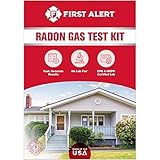 First Alert RD1 short-term radon test kitA charcoal canister you leave out for a few days and mail to a lab; the lab fee is part of the kit.$16.98 Price seen on Amazon Oct 21, 2026, 12:34 PM ETDetails at Amazon ›
 Airthings Corentium Home radon monitorA battery digital monitor that shows short and long-term radon averages on its screen, no app needed.$146.04 Price seen on Amazon Oct 21, 2026, 12:34 PM ETDetails at Amazon ›
Product prices and availability are accurate as of the date/time indicated and are subject to change.
The two picks above came from reading the makers' published instructions and a long scroll through owner reviews for recurring complaints, not from any trial we ran. They pair well for this question: the charcoal kit gives you a lab-analyzed snapshot, and a battery monitor with its own screen builds the long-term average while you wait. Our guide to choosing a radon detector compares the kinds of detector in more depth.
Why does the reading change so much?
Radon indoors is never one number. It moves on at least three clocks.
The seasonal clock is the biggest. In cold weather, warm air rising and leaking out of the upper house leaves the basement at slightly lower pressure than the soil, and soil gas is drawn in. Windows stay shut. In many homes, winter readings run well above summer ones. A minority of houses buck that pattern, which is one more reason a long-term test beats any rule of thumb.
The daily clock is smaller but easy to see on a continuous monitor: readings often climb overnight and early in the morning and sag in the afternoon. Then there is the weather clock. A falling barometer ahead of a storm, a stretch of strong wind, soaked or frozen ground that caps the soil around the house: each can push readings up for a day or two.
To put that in hypothetical numbers, a basement that averages 3 pCi/L across a year could plausibly read 5 during a cold January week and 1.5 in a breezy week in May. Test only in May and you would relax. Test only in January and you would call an installer the next morning. Neither week is the answer. The year is.
What should you do at each level?
These steps follow the EPA's published guidance plus the international reference points above. Read the current version at the source, the EPA's radon pages, before you decide anything costly.
| Long-term or averaged result | Where it sits | What people usually do |
|---|---|---|
| Below 2 pCi/L (under 74 Bq/m³) | Below the EPA's consider-fixing point and the WHO reference level | No fix. Retest every few years and after big changes such as finishing the basement. |
| 2 to 4 pCi/L (74 to 148 Bq/m³) | EPA suggests considering a fix; above the WHO level from about 2.7 | Run a long-term test if you have not. Weigh a fix more heavily if anyone smokes or spends long hours on that level. |
| 4 to about 8 pCi/L (148 to 300 Bq/m³) | At or above the EPA action level; above Health Canada's guideline from about 5.4 | Confirm with a second test, then fix. Get more than one quote from a certified installer. |
| Above about 8 pCi/L (over 300 Bq/m³) | Above every reference level listed here, including the EU ceiling | Run a quick second short-term test while you line up installers. Do not wait a season. |
After any fix, wait at least a day with the system running, test again, and keep testing every couple of years. A typical sub-slab system, a pipe and a fan that pull soil gas from under the floor and vent it above the roof, is the usual remedy, and our earlier piece on radon testing and fixes explains how it works.
Questions
Is 1 pCi/L safe?
It is below every published reference level and close to the U.S. indoor average, so no agency recommends a fix there. "Safe" is still the wrong word, because risk does not drop to zero. In practice, a long-term 1 means you can stop worrying and retest now and then.
Is 100 Bq/m³ more or less than 4 pCi/L?
Less. Divide by 37 and 100 Bq/m³ comes to about 2.7 pCi/L, while 4 pCi/L is 148 Bq/m³. That is why a house can pass the EPA's action level and still sit above the WHO's reference level.
Why do countries use different numbers?
They read largely the same risk evidence but make different calls about cost, how many homes would need work, and what fixes can reliably achieve. None of the figures marks the edge of safety. They mark where each body thinks action is worth recommending.
My test came back at 2.4 pCi/L. Is a fix worth it?
The EPA suggests considering one in that range, and the WHO's reference level sits just above it. If the 2.4 came from a short winter test, run a long-term test first; the year may be lower or higher. If a long-term average confirms it and the basement is lived in, a fix is often straightforward and brings the number well down.
Write your result on the lab report in both units, pCi/L and Bq/m³, and tape it inside the furnace room door with the date. The next time you test, you will be comparing against your own house instead of a headline, which is the most useful comparison of all.