How much firewood do you need for winter? Cords, face cords, ricks
There's no single answer, and anyone who offers one without asking where you live is guessing. A household that heats mainly with wood in a cold northern or mountain climate commonly goes through several full cords in a winter. One that lights the stove on cold evenings and weekends, with a furnace or heat pump doing the rest, may burn a single cord or less. The best estimate is your own: measure what you start with, see how fast it goes, and buy in full cords so the numbers mean something.
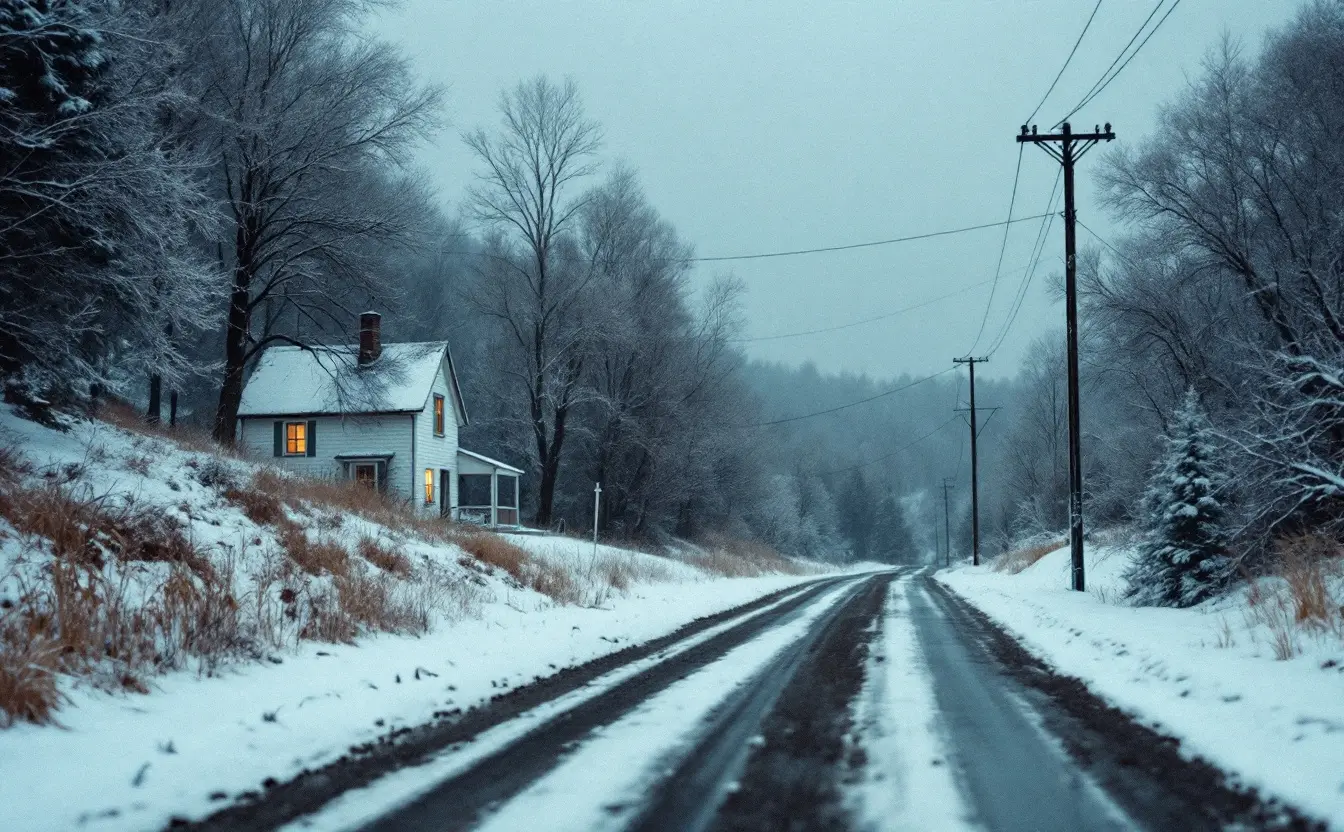
Our farmhouse sits in a cold valley bottom, and since the stove became backup to a heat pump, our own number has dropped a long way from the winters when wood did all the work. Here's how I think it through, from the units sellers use to the stacks behind the shed.
What is a cord, a face cord and a rick?
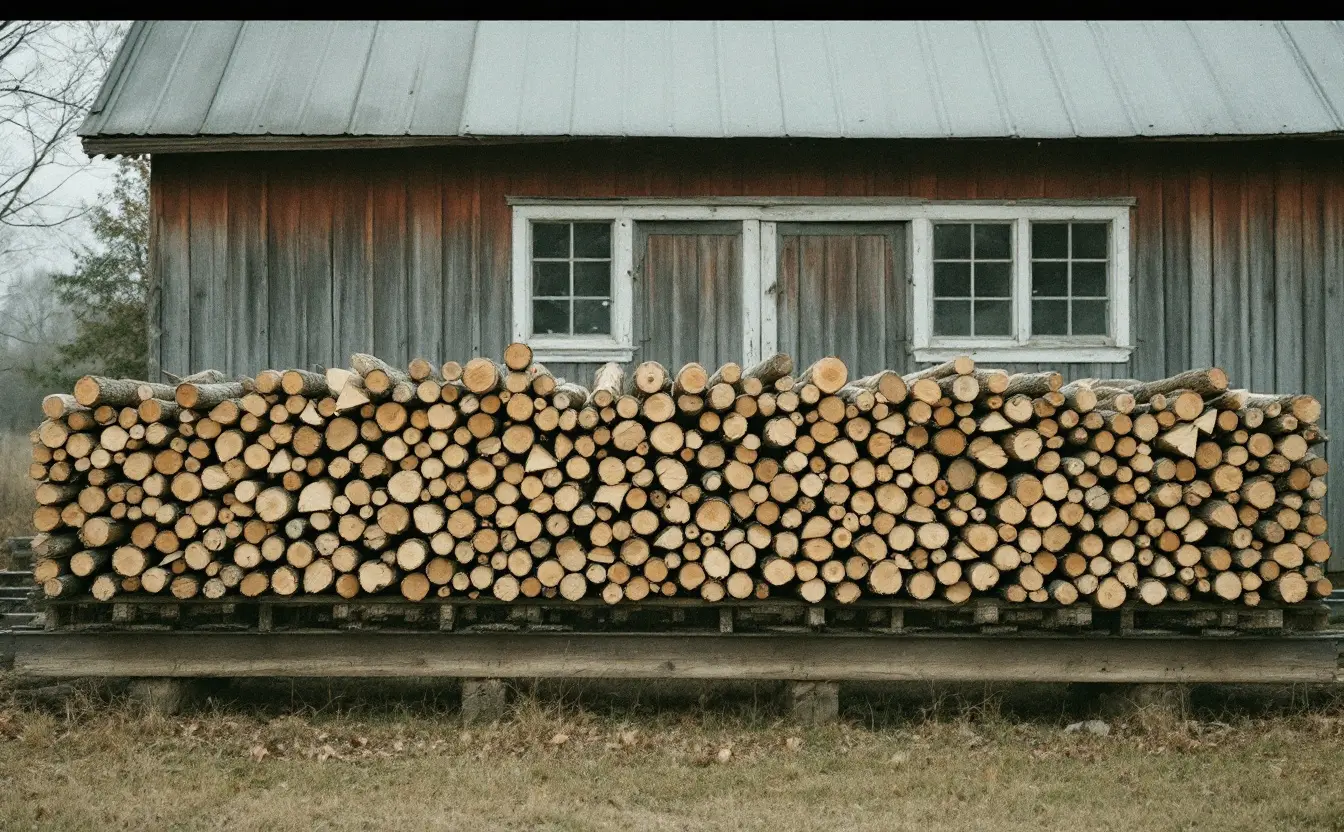
A full cord is wood stacked tight in a block 8 feet long, 4 feet high and 4 feet deep. That makes 128 cubic feet, and the gaps between the pieces count toward it. It's the one unit with a fixed meaning, and many states' weights-and-measures rules expect firewood to be sold by the cord or a stated fraction of one. Check what your own state publishes if a seller's terms seem slippery.
A face cord is a single row 4 feet high and 8 feet long, as deep as the pieces are long, so its size depends on how the wood was cut. With 16-inch pieces, a common length for household stoves, a face cord is a third of a full cord. "Rick" often means a face cord, but not everywhere, and "truckload" means whatever the truck held that day.
| Unit | Stack size | Share of a full cord |
|---|---|---|
| Full cord | 4 ft high, 4 ft deep, 8 ft long | All of it (128 cubic feet) |
| Face cord, 12 in pieces | 4 ft high, 8 ft long, one row | A quarter |
| Face cord, 16 in pieces | 4 ft high, 8 ft long, one row | A third |
| Face cord, 24 in pieces | 4 ft high, 8 ft long, one row | Half |
| Rick | Varies by region and seller | Ask for dimensions |
| Truckload | Depends on the truck and how it's loaded | Ask, then measure |
Before you agree to anything other than a full cord, ask for the stack's length, height and piece length in feet and inches. If the seller can't say, that tells you something too.
About these links: some go to Amazon and partner shops and may earn us a commission. As an Amazon Associate I earn from qualifying purchases.
How do you use the firewood cord calculator?
Our firewood cord calculator turns a stack's measurements into full cords and face cords. It asks for four numbers: the stack's length, its height, its depth from front to back, and the piece length. Length, height and depth go in feet and the piece length in inches, and a toggle switches the whole form to meters and centimeters.
It shows the stacked volume in full cords, with a band that says whether that's less than half a cord, between half and a full cord, or more than a full cord. Below that it lists how many face cords of your piece length the stack holds, what share of a full cord one of those face cords is, and the volume in cubic feet and cubic meters. With its starting values (8 feet long, 4 high, 4 deep, 16-inch pieces) it reads 1 full cord, 3 face cords, a face cord equal to 33 percent of a full cord, and 128 cubic feet, or 3.62 cubic meters.
One detail trips people up. For a single row, the depth is the piece length, so a row of 16-inch wood is about 1.33 feet deep. Enter that, not 4.
How do you measure a delivered stack?
Wood dumped loose in the driveway can't be measured fairly, because thrown splits take up more room than the same wood stacked. Stack it first, then measure.
- Stack it tight, pieces parallel, in rows on rails or pallets, the way you'd store it anyway.
- Measure each row's length along its middle, not along the bulging bottom course.
- Measure the height at three or four points along the row and average them. Stacks are never flat on top.
- Measure the depth. For a single row, measure a handful of pieces and use the typical length. For two rows side by side, measure the full depth front to back.
- Enter the numbers in the calculator, one row at a time if your rows differ.
- Compare with what you were sold, and talk to the seller promptly if it's well short.
Here's an example. A single row 12 feet long and 4 feet high of 16-inch splits goes in as 12, 4 and 1.33, with a piece length of 16. The calculator shows 0.5 full cords, or 1.5 face cords of that length. If you were promised a full cord, you're looking at half of one.
A few honest caveats. Crisscrossed end towers hold a little less wood than solid rows, and crooked, knotty pieces leave bigger gaps than straight-grained ones. Green wood also shrinks a little as it dries, so a stack measured in spring looks a touch smaller by fall. None of that explains a big shortfall.
How much firewood does a household burn?
The amount swings widely from one house to the next, and these are the things that swing it:
- Climate. A winter in northern Minnesota or a high Rockies valley asks for far more heat than one in the Ozarks or the Carolina Piedmont.
- The house. Size matters, and so do insulation and air leaks. Sealing a drafty old house can cut wood use more than a new stove; the Department of Energy's Energy Saver pages cover the basics.
- The stove. A modern certified stove gets more heat into the room from each load than an old leaky box. An open fireplace can send more warmth up the chimney than it gives back.
- The wood. Dense hardwoods like oak and hickory hold more heat per cord than pine or poplar, because a cord of dense wood simply contains more wood. Dry wood gives far more usable heat than wet wood, which spends energy boiling off its own water.
- How you use it. Wood as the main heat, all day and every day, is a different budget from a fire on cold evenings. So is a house kept at 72 compared with one where everyone owns a good sweater.
Words like "several cords" and "a cord or less" are about as precise as anyone can honestly be without seeing your house and your winter, which is why your own records beat any chart.
How do you work out your own number?
- Start the season with a measured stack. Run it through the calculator and write down the full cords.
- Measure again after a typical cold month. The difference is a month's use at that kind of weather.
- Scale it to your heating season, giving the deep-winter months more weight than the shoulder weeks of fall and spring.
- Add a cushion for a long cold spell or a late spring. Running out in March means buying whatever wet wood is left.
- Write it all down. Next fall, the notebook beats any rule of thumb.
If you're switching to wood from another fuel, the first winter is a guess, so buy generously and carry the surplus forward. Dry wood stored well doesn't spoil.
How should you plan and store a winter's supply?
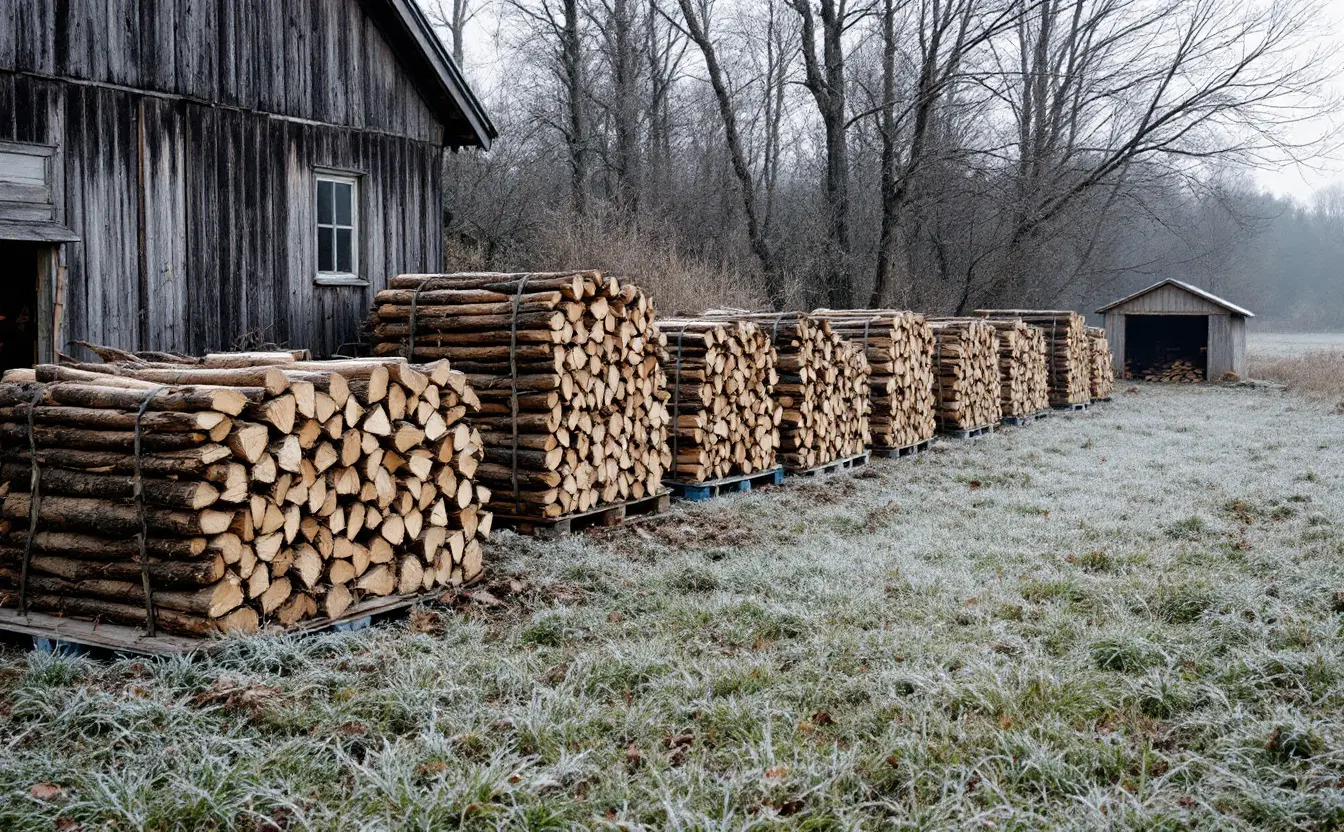
The hard part of firewood isn't the amount, it's the timing. Most split hardwood needs about 6 to 12 months stacked to dry, and oak often longer, so the wood you'll burn next winter should be split and stacked by spring. Our guide on how to tell if firewood is seasoned covers drying and checking in detail. Plenty of households keep two stacks: this winter's, dry and under a roof, and next winter's, drying in the sun and wind.
Space adds up quickly. A full cord of 16-inch wood in a single row 4 feet high runs 24 feet long, so a winter's supply can eat a whole fence line. Keep the main stacks off the ground, top covered and sides open, and well away from the house walls. Near the door, keep only a few days' worth; a big pile against the siding invites insects and holds damp against the wall.
Before the first cold night, carry a few splits in, let them warm to room temperature and check them with a meter. A canvas carrier makes the daily trips easier on the floors and on your back.
- General Tools MMD4E pin moisture meterA pin meter for split firewood: push the pins into a fresh split face for a reading in percent.Details at Amazon ›
- Waxed canvas log carrierA canvas sling that carries an armful of splits indoors without a trail of bark.Details at Amazon ›
Both of these are here because of what their manufacturers state and what owners keep saying after a season or two at the woodpile. I can vouch for the kind of tool, not for a bench comparison, because there wasn't one. The meter is the one that protects your wood budget; the carrier mostly spares you the sweeping. For thermometers, alarms and the rest of the stove corner, see our wood stove accessories guide.
Questions
Is a rick the same as a face cord?
Often, but not reliably. In the places where people say "rick," it usually means a single row 4 by 8 feet, as deep as the pieces. Elsewhere the word means whatever the seller is used to, so ask for the dimensions and the piece length.
How long does a cord of wood last?
It depends on the same things as the season total: climate, house, stove, wood and how often you burn. A cord burned as the main heat in deep winter goes much faster than a cord saved for weekend fires. Track one cold month and you'll know.
Is it better to buy firewood in spring or fall?
Spring, if you have room to stack it. Green wood bought early usually costs less and has the whole summer to dry. Wood bought in October is often labeled seasoned and often isn't.
Can I store a winter's firewood in the garage?
A week's supply, fine. A whole winter's worth indoors brings insects inside and dries slowly, since a closed garage has little airflow. Keep the main stacks outside under a roof.
Should I buy more than I think I need?
Within reason, yes. Dry wood keeps for years under cover, and a cushion means you never end up burning wet wood in March because the stack ran out. There's a quiet satisfaction in a row you didn't need, still waiting by the shed when the spring peepers start calling.