Water & Rivers · Science & Explainers
What fallen leaves do in a creek: inside the leaf-pack food web
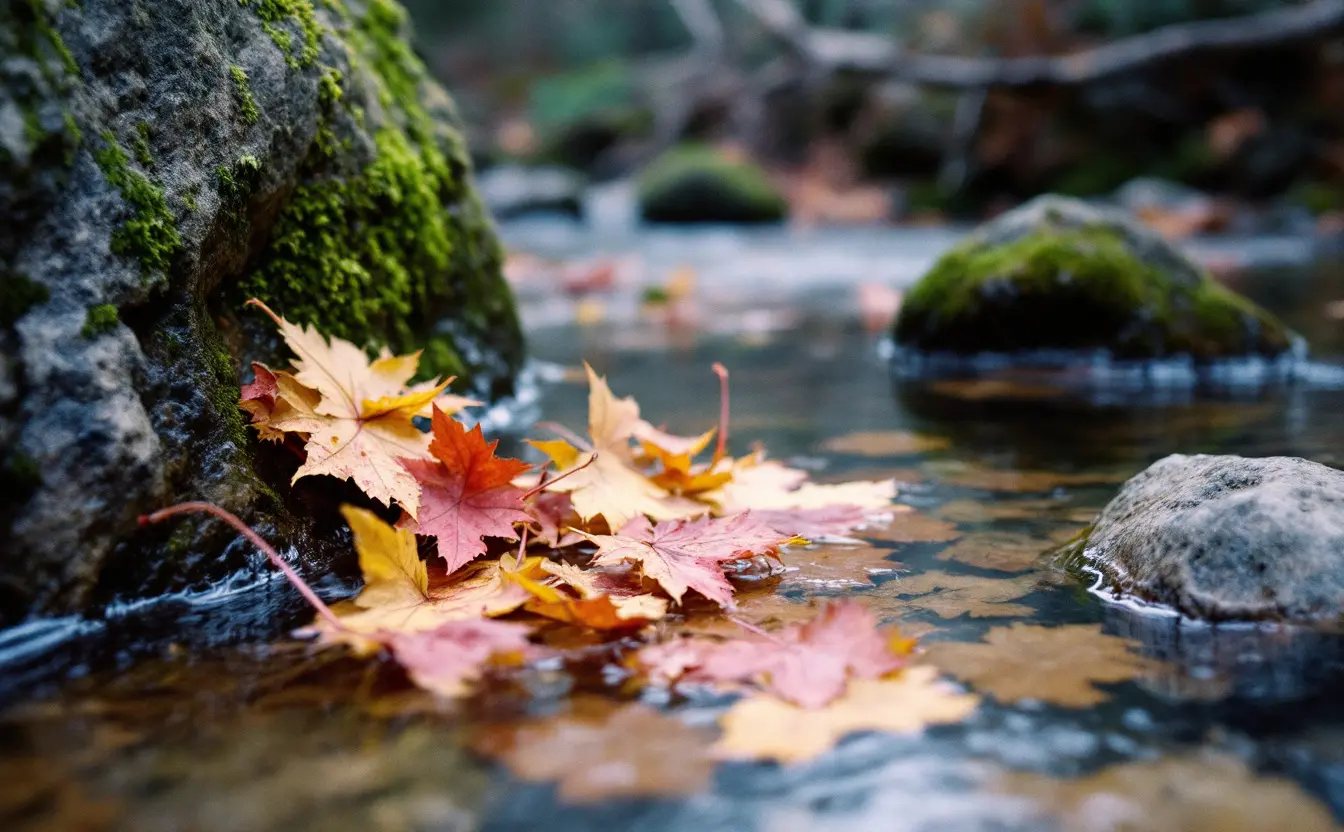
Stand on a footbridge over a small woodland creek in late October and watch for a while. A sugar maple leaf lands on the current, spins once, and rides down to the head of a riffle, where it plasters itself against a stone that already holds a dozen others. Within a couple of weeks that stone will wear a thick, soggy bib of red, yellow and brown. Most people see a creek clogging up with debris. A stream ecologist sees the winter food supply arriving on schedule.
Those wet mats are called leaf packs, and in a forested headwater stream their arrival may be the biggest event of the year. The creek doesn't so much receive the autumn as eat it, slowly, through the cold months, with the help of fungi, bacteria and a crowd of insect larvae most people never notice.
A creek that lives on its neighbors' leftovers
Small streams under a full canopy are dim places in summer. The sunlight that reaches the water is patchy, so algae on the rocks grow thinly, and algae are the base of the food web in a lot of sunnier waters. In shaded headwaters, a large share of the energy comes from outside the stream instead: leaves, twigs, seeds, bark, insects that fall from the branches. Ecologists have a dry word for food that comes from elsewhere, allochthonous, but the idea is simple. The forest feeds the creek.
The pattern shifts as you go downstream. One of the classic ideas in stream ecology, the river continuum concept, describes how a river's food base changes from leaf-fed headwaters, to wider and sunnier middle reaches where algae on the stones do more of the work, to big rivers where fine organic particles drifting from upstream matter most. The headwaters are the leaf eaters. In the eastern hardwood forests, nearly all of their yearly leaf delivery comes down in a few weeks of autumn.
About these links: some go to Amazon and partner shops and may earn us a commission. As an Amazon Associate I earn from qualifying purchases.
The first days: tea and softening
A dry leaf that hits the water starts losing material almost at once. Sugars, tannins and other soluble compounds leach out over the first day or two, which is part of why some creeks run faintly tea-colored in fall. What's left is mostly tough structural tissue, cellulose and lignin, that very few animals can digest on their own.
That's where the microbes come in. Within days, aquatic fungi colonize the leaf surface and push threads into the tissue. Many belong to a group called aquatic hyphomycetes, which make elaborate, star-shaped spores that drift in the current and snag on fresh leaves downstream. Bacteria join them. Together they soften the leaf and, more important, enrich it, because the microbial film is far richer in protein and nitrogen than the leaf itself.
Stream ecologists have long compared this to peanut butter on a cracker. The leaf is the cracker, filling but not very nourishing; the fungi are the peanut butter. Many leaf-eating insects grow poorly on sterile leaves and much better on well-colonized ones, and in feeding experiments some pick the conditioned leaf over a fresh one. A leaf that has soaked in the creek for a few weeks is, in a real sense, a better meal than it was the day it fell.
 Pocket TDS meter (TDS, EC and temperature)A pen meter that reads total dissolved solids, a quick way to track changes in well or filtered water.Details at Amazon ›
 17-in-1 drinking water test stripsDip strips for a first screen of hardness, pH, iron, copper, nitrate, nitrite and other markers.Details at Amazon ›
- Muck Boot Company bootsWaterproof rubber boots for mud, wet trails, creek banks and barn chores.At Muck Boot ›
Who eats the leaves
Pull apart a leaf pack in November and you'll find it busy. Biologists often sort the residents by how they eat rather than by family, because the roles fit together like parts of a machine.
| Feeding group | What they do | Animals you might find |
|---|---|---|
| Shredders | Chew conditioned leaves into fragments | Leaf-case caddisflies, giant and winter stoneflies, crane fly larvae, scuds, aquatic sowbugs |
| Collectors | Filter or gather the fine particles shredders leave behind | Net-spinning caddisflies, black fly larvae, many mayflies, midges |
| Scrapers | Graze the slick film on stones and old leaves | Flat-headed mayflies, water pennies, some snails |
| Predators | Eat the others | Common stoneflies, hellgrammites, dragonfly nymphs, sculpins, salamander larvae, young trout |
Shredders are the stars of the pack. Some caddisfly larvae build their portable cases from bits of leaf and bark, so they wear their dinner. Giant stonefly nymphs, which can take more than a year to mature, chew leaves down until only a lacy skeleton of veins remains. Scuds, small shrimplike crustaceans, can swarm over the packs in cold, spring-fed streams.
Shredders are messy eaters, and they don't digest much of what they swallow. The crumbs and droppings they leave, fine particles of half-processed leaf, drift downstream and feed the collectors: net-spinning caddisflies that stretch silk between stones, black fly larvae waving fan-shaped mouthparts in the current, mayflies that gather particles from the bottom. A single leaf passes through several bodies before it's gone.
Then come the predators. Common stoneflies and hellgrammites hunt through the pack. Sculpins, salamander larvae and young trout pick off whatever wanders into open water. Along eastern creeks the Louisiana waterthrush, a small warbler that bobs its tail constantly, makes its living on these insects in spring and summer, and in the mountain West the American dipper walks straight into fast water to hunt them. Trace much of the life in a small stream back far enough and you arrive at a maple or an oak on the bank.
If the animals in that table are new to you, our beginner's guide to volunteer stream monitoring has a short field guide to the regulars in a sorting tray.
Not all leaves are equal
Toss a handful of mixed leaves into a creek and they won't vanish together. Soft, nutrient-rich leaves such as basswood, alder, ash and many maples break down fast, often within weeks to a couple of months. Oak and beech are tougher and loaded with tannins and lignin, and they can hang on through winter and into spring. Rhododendron leaves, thick and waxy, are slower still, and conifer needles barely seem to change for months.
At first glance the slow leaves look like poor relations, but the mix matters. Fast leaves feed the creek in late fall, when many shredders are small and growing quickly. Slow leaves are the pantry, still there in February and March after the fast ones are long gone. A stream lined with many kinds of trees gets a supply that lasts. A stream lined with one kind gets a feast and then a gap.
That's why changes on land show up in the water. Where emerald ash borer has killed ash trees, a fast-decaying leaf has dropped off the autumn menu. Where hemlock woolly adelgid has killed eastern hemlocks, streams have lost deep year-round shade and a steady trickle of needles, and hardwoods or rhododendron often fill the gap. Each shift reshuffles what the stream gets to eat, and when.
Holding on to the harvest
A leaf that washes straight through a stream does it little good. What keeps leaves in place long enough to be eaten is structure: boulders, root wads, gravel bars and, above all, fallen wood. A log across a small creek works like a comb, catching leaves and turning a fast chute into a pool with a fat pack at its head. Streams that have been straightened, cleared of wood or lined with riprap tend to hold far less of their autumn delivery.
So the old habit of tidying a creek by hauling out the deadfall can quietly starve it. Unless wood is threatening a culvert or a bridge, it's usually doing the stream a favor right where it lies.
Leaves in the wrong place are a different matter. In towns, leaves raked or blown into the street end up in gutters and storm drains, where they steep in puddles and leach nutrients, especially phosphorus, into pipes that run straight to the nearest lake or river. Research in Midwestern cities has found that street leaves can be a major source of the phosphorus in autumn stormwater, which feeds algae blooms downstream. The fix is mundane: keep leaves on the lawn, in garden beds or in the compost, and off the curb.
The same story in other forests
The details change with the region, but the pattern holds wherever trees shade water. In the Pacific Northwest, red alder and bigleaf maple leaves drop into coastal creeks in the same weeks that spawning salmon die and add their own nutrients to the stream. In the Rockies, aspen, willow and cottonwood leaves fall into snowmelt creeks shortly before ice forms. In the southern Appalachians, tulip poplar and sycamore go in early, with oak and rhododendron trailing behind. Across New England and the Great Lakes states, sugar maple and beech dominate the delivery.
The timing follows the trees, and the trees follow elevation and latitude. If you've ever chased color down a mountainside, as in our piece on fall color by elevation, you've also watched the creeks' food supply move downhill week by week.
Looking inside one yourself
You don't need a net to see any of this. On a mild day in November or early December, find a shallow riffle with a few packs caught on the stones and bring a white dish or a plastic tub.
Fill the tub with a few inches of creek water. Lift one pack gently from the downstream side so the animals don't wash out, set it in the water and give it a minute to settle. Then tease the leaves apart one at a time and look closely at each: the slick, darker film of fungi and bacteria, the half-moon bites along the edges, the leaves eaten down to a net of veins. Watch for movement among the fragments. A caddisfly might back out of its leafy case, a scud might skitter across the bottom, a small stonefly might cling to a vein and refuse to let go.
When you're done, slide everything back into the same spot. Wash your hands, and if you're heading to a different stream, rinse and dry your boots first. For what else is happening along the water as the season turns, the field almanac runs month by month.
Most of the leaves you lifted out will be gone by spring, turned into insects, then into fish and birds, then into the next generation of insects. What's left in the riffle in April is mostly oak, ragged and soft and still feeding someone.