Water & Rivers · Science & Explainers
Acid mine drainage, and why some mountain creeks run orange
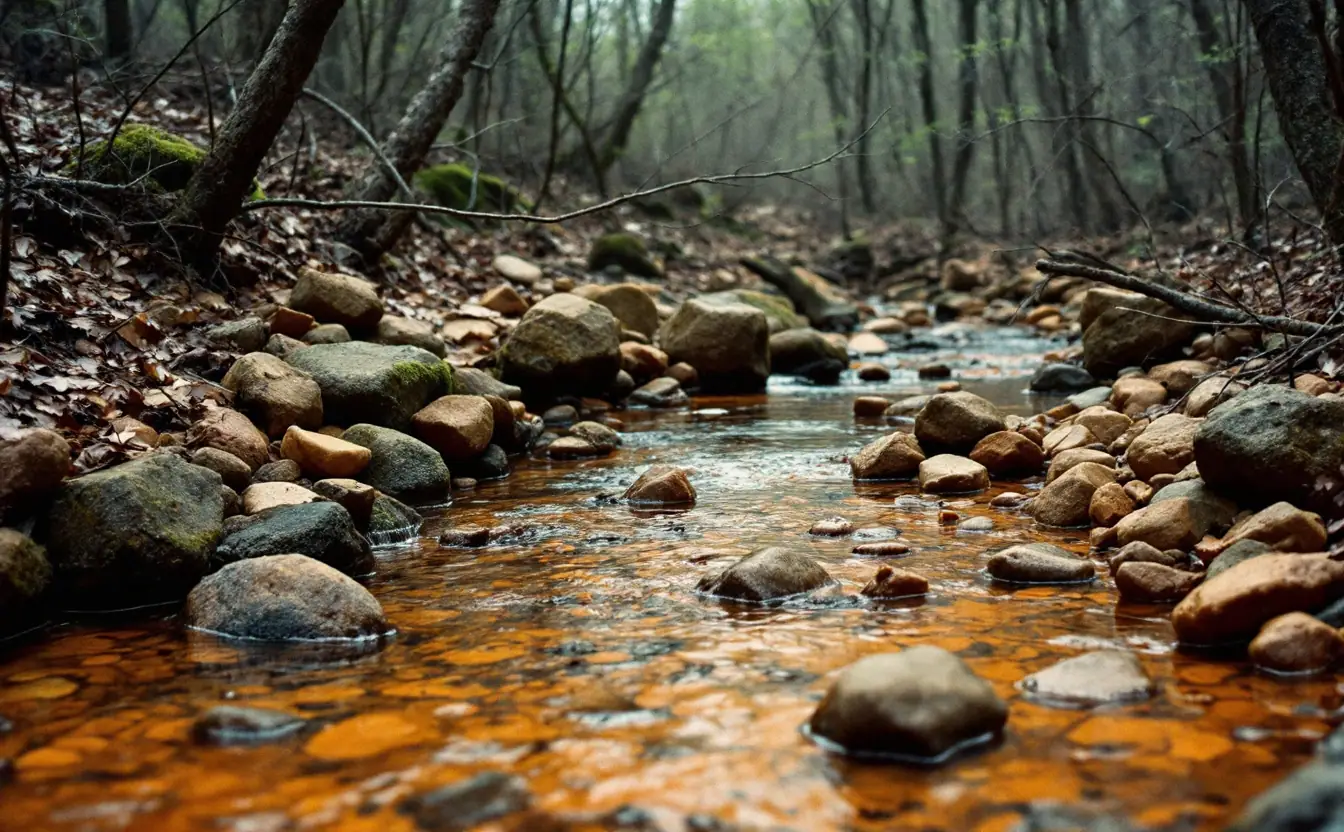
The first orange creek I ever sampled looked, from the road, like somebody had poured a can of paint into it. Up close it was worse and more interesting. Every cobble wore a soft orange coat that smeared off on my glove like wet rust. There was no green film of algae on the stones, no caddisfly cases, nothing darting away when my shadow hit the water. The creek was clear, cold and almost empty.
That color has a name in coal country, "yellow boy," and a cause that runs back through the rock to the moment someone opened a mine. Acid mine drainage is one of the most widespread water problems in the Appalachian coalfields and in the old metal-mining districts of the West. It's also one of the more fixable ones, which is the part that tends to get left out.
It starts with fool's gold
The culprit is pyrite, an iron sulfide mineral better known as fool's gold. It's common in coal seams and in the shale and sandstone around them, and it's often abundant in the rock surrounding deposits of gold, silver, copper and other metals. Sealed underground, away from air, pyrite can sit unchanged for millions of years.
Mining changes that. Tunnels, open pits and piles of broken rock expose enormous surface areas of pyrite to oxygen and water at once. The mineral oxidizes, and the reaction produces two things that matter to a stream: dissolved iron and sulfuric acid. Water seeping through the workings picks up both and carries them out of a portal, a seep at the base of a spoil pile, or a crack in a hillside.
Then biology joins in. Certain iron-oxidizing bacteria thrive in acidic water and dramatically speed up one of the slower steps in the chain, converting dissolved iron into a form that attacks more pyrite. The process feeds itself: more acid supports more bacteria, which make more of the oxidizer, which dissolves more pyrite. That's why a mine can keep discharging polluted water for decades after the last coal left it.
Where the orange comes from
Inside the mine, in acidic water with little oxygen, the iron stays dissolved and nearly invisible. The color appears when the drainage reaches open air and mixes with less acidic water downstream. The iron oxidizes further and drops out as iron hydroxide, a fluffy orange-to-yellow solid that settles on everything it touches.
Iron isn't the only metal riding along. Acidic water dissolves aluminum from clay minerals, and when the pH rises downstream, aluminum can precipitate as a whitish coating, sometimes visible as a milky cloud where an acidic tributary meets a cleaner one. Manganese can leave black stains on rock. In the metal-mining West, the mix can include zinc, copper, cadmium and lead.
The chemistry leaves a recognizable signature in water data: low pH, high conductivity, high sulfate, and high concentrations of iron, aluminum and manganese. Severe discharges can fall below pH 3, close to the acidity of vinegar. If you're trying to make sense of numbers like those, our guide to reading a stream water quality report covers the units and the shorthand.
Not every mine discharge is acidic, though. Where the surrounding rock includes limestone or other carbonate minerals, they can neutralize the acid as it forms. The result is "net alkaline" drainage, still loaded with iron and still orange, but not very acidic. Its effects on a stream are different, and so is the way it's treated.
What it does to a creek
The damage comes in layers. Low pH stresses or kills many fish and insects outright, and dissolved aluminum is especially hard on fish because it interferes with their gills. Mayflies, among the most acid-sensitive insects in a stream, are often the first to disappear.
Then there's the coating itself. Iron precipitate settles into the spaces between cobbles and gravel, exactly the spaces where stream insects live and where trout and other fish lay their eggs. A streambed that should look like a jumble of rocks with dark crevices turns into a smooth orange crust. Algae struggle to grow on it, so the base of the food web thins out as well. A few tough organisms hang on, including some midges and certain caddisflies, but diversity collapses.
The effect can run for miles. A single large discharge can leave a long reach of stream nearly lifeless below it, until enough clean water arrives from tributaries to dilute and neutralize it.
Why so many old mines still leak
Much of the drainage comes from mines abandoned long before modern reclamation rules. The federal Surface Mining Control and Reclamation Act of 1977 set requirements for mining companies to restore land and manage water, but it couldn't reach back and assign responsibility for workings closed generations earlier. For many of those sites there is no company left to call. The same law set up a fund, paid for by a fee on coal production, to help deal with abandoned mine lands, and public programs and nonprofit groups have drawn on it and other money to tackle problem sites.
Plugging a mine opening sounds like a quick fix and often isn't. Water keeps moving through the old workings, and if you seal one exit, pressure can build until the water finds another way out, sometimes as a sudden blowout. Metal mines in the Rockies have their own long history with this. In 2015, a release of mine water from the Gold King Mine above the Animas River in Colorado turned the river a vivid mustard color for days and became national news.
How creeks get their color back
Treatment falls into two broad camps, and many watersheds use both. The choice depends on how much water a site discharges, how acidic it is, and how much land and money are available.
Active treatment means adding an alkaline chemical, usually some form of lime, to neutralize the acid, then letting the metals settle out in ponds. It handles difficult water and works reliably. It also needs power, chemicals and people to keep it running indefinitely.
Passive treatment relies on gravity, limestone and biology. Water may run through buried limestone beds sealed from the air, through open channels lined with limestone rock, through layered cells of compost and limestone, or through constructed wetlands where bacteria and plants help strip out metals. Settling ponds give iron a place to drop out before the water moves on. Passive systems cost less to run but need space and periodic upkeep, and they suit some water chemistries better than others.
Some watershed groups also spread crushed limestone sand directly into streams, so the current carries it downstream and neutralizes acid along the way. A few projects have even dried the recovered iron sludge and turned it into pigment for paint.
The payoff can be striking. The Cheat River in northern West Virginia, once known for orange stretches, has become one of the region's better-known recovery stories after years of treatment work upstream. In many smaller Appalachian watersheds, mayflies return first, then minnows, then trout. The ground around old mines can come back in surprising ways too, which Ruth Ann Sizemore explores in life on reclaimed mine land.
Questions people ask about orange creeks
Is all orange water from mines? No. Iron-rich groundwater seeping from wetlands and hillsides feeds iron bacteria that make orange slime and a rainbow sheen on still water, even where there's no mining history at all. For a quick field test, poke the sheen with a stick. A bacterial film breaks into flat plates and stays broken, while an oil sheen swirls and flows back together.
Is it dangerous to touch? Brief contact while wading or crossing is not usually the main concern; the acidity and metals matter far more to the animals living in the stream than to your boots. Still, rinse your hands and gear afterward. Keep dogs from drinking it.
Can I drink it if I filter it? No. Backpacking filters remove bacteria and protozoa, not dissolved metals or acidity. Carry water from a cleaner source.
Will the orange wash away in the next flood? A big flow can scour some deposits, but as long as the discharge keeps running, the coating comes back. The stream recovers only when the source itself is treated.
Is this only a coal problem? No. Coal regions in Pennsylvania, West Virginia, Ohio, Kentucky and parts of the Midwest have it. So do hard-rock mining districts in Colorado, Montana, California and elsewhere in the West.
How long does recovery take once treatment starts? It varies a great deal. Water chemistry can improve quickly below a working system, but the iron crust on the streambed takes time to wash away, and insects and fish have to recolonize from cleaner water nearby. Expect seasons to years, not weeks.
How can I help? Many coalfield watersheds have volunteer groups that sample treatment systems and the streams below them, and some need help with plain maintenance like clearing leaves from limestone channels. Our beginner's guide to volunteer stream monitoring is a good place to start, and the next orange creek you cross is a good place to start asking who's watching it.
Hollow & Headwater is an independent publication. Nothing here is official guidance – for permits, rules or emergencies, go to the relevant public authority.